18 March 2013

Cyprus bailout: The wrong signal


Cyprus, the eastern Mediterranean island, becomes the fifth country to be rescued: euro zone Finance Ministers agreed on a EUR 10 bn loan; the novelty of the rescue is a tax on deposits with banks in Cyprus to amount to EUR5.8 billions. Mrs Merkel (and nobody contradicted her) found that Cyprus is a centre for money laundering (from Russia and the Middle East) and therefore depositors should be taxed to participate in the bailout; well, if it is the case (and probably it is), the country should not have been admitted within the euro zone in the first place and probably the EU, since these accusations have been running for so many years; by the way, France, the UK, Luxembourg, The Netherlands, Italy, Spain should also be concerned (money laundered via banks and/or real estate). Others explained that a EUR 17 billion loan would overburden the debt/GDP ratio in a way where Cyprus would not be able to repay which is right at 200%. Frankly, EUR 10 billion lending does not change the conclusion anyway, at +/- 150% ratio.
Bank accounts were frozen and the tax will be immediately levied on Tuesday when banks reopen (subject to a positive vote at the Parliament of Cyprus).
The levy is:

6.75% tax on deposits below EUR 100,000

9.9% tax on deposits above EUR 100,000

I would remind the reader that Cyprus banks were meant to go under immediately after the haircut was decided on Greek debt (EUR 4.5 billion loss) and nobody foresaw the problem coming? I do not believe it but since the fiscal situation of Cyprus has deteriorated markedly (oh! Yes, I had forgotten that Presidential elections in Cyprus were held late February 2013…).

Besides the morally disputable action –why punishing the honest citizen who has saved all his life and in addition may have loans on the other side? – It is a very dangerous action sending a clear signal to all European citizens and the rest of the world: Europe is no longer a safe place for depositors; we knew that artificially low rates and rising inflation were in motion to deprive savers, but Saturday’s decision is a leapfrog in the wrong direction. I understand Mrs Merkel who wants to send a tough signal to her public opinion and Parliament. I am not either convinced by the reason given by the Dutch Finance Minister Jeroen Dijsselbloem: “As it is a contribution to the financial stability of Cyprus, it seems just to ask a contribution of all deposit holders”, so what about the Greeks, Portuguese, Irish and Spanish? And what about senior and junior lenders: I would be most interested to see whether they will be hit and if yes, in which magnitude (no details on this-probably banks mainly financed themselves via deposits; I did not look at aggregated Cypriot bank’s balance sheets)?

This is creating a precedent which will hit the confidence in the euro zone institutional environment and safety for depositors. Despites all assurances yesterday and today, particularly in Spain, that Cypus is a special case (it is ALWAYS a special case), residing in a trouble euro zone country, I would be very very worried and would not wait to get most of my saving in a safe place (i.e. outside the euro zone -the nearest is London). No depositor in the euro zone is safe any longer with his savings: each country could impose such a tax for whatever reason, good or bad (remember Roosevelt stealing gold from Americans in April 1933). This would be politically correct: tax all deposits above EUR100.000 in countries receiving EU money, and why not in countries with disastrous public account (France and Italy). Not the way forward for a sustainable fiscal consolidation to create the bedrock of future prosperity.

In the meantime France will not abide by the Maastricht criteria in 2013 (and 2014, I bet), or 8 years over the past 11, without any sanction, despite repeated assurances. Another wrong signal: the rules do not apply the same way to every euro zone country.

Source:

Bloomberg: Europe Braces for Fresh Turmoil With Cyprus Deposit Levy


http://www.bloomberg.com/news/2013-03-17/europe-braces-for-renewed-turmoil-as-cyprus-deposit-levy-at-risk.html

Financial Times: Cypriot bank deposits tapped as part of €10bn eurozone bailout

http://www.ft.com/intl/cms/s/0/33fb34b4-8df8-11e2-9d6b-00144feabdc0.html#axzz2NphVijdj

11 March 2013

The Airline Industry: Challenges, Economics and Innovation

The Airline Industry: Challenges, Economics and Innovation

 http://www.youtube.com/watch?v=N27yYgL-iIg

The Airline Industry: Challenges, Economics and Innovation


Energy is at the center of human life and the harnessing of electricity is probably of the same magnitude as the harnessing of fire: there would be no modern life without electricity.
Since the 19th century’s industrial revolution, fossil fuels together with innovation have been the main drivers of development. Much has been said about climate change, and other side effects on health or how much energy prices can weight on the purchasing power of citizens and hamper economic development.

The airline industry is a point in case where kerosene represents 30+% of all costs, making it hardly profitable. A lot of efforts are made to move as much as possible towards electricity (for example for taxing) by engine suppliers (Safran, GE, Rolls Royce, Mitsubishi Heavy Industries to name the largest players).

1. The airline industry: a few metrics

Air Cargo transported over USD5.3 trillion worth of goods in 2010 or 35% of world trade in value. The air freight industry has grown 3 times quicker than the international trade and 4 times the world GDP for the past 30 years.

Passenger’s traffic has doubled during the past 15 years and will again double in the next 15 years to transport 9 billion customers.

The world airline industry generated USD 637 billion revenues in 2012 and is forecasted to grow 5% a year to 2050.

Boeing and Airbus are projecting the delivery of 28,000-34,000 new airplanes by 2031.

Engines represent c. 20% of the cost of an airplane.

Fuel consumption amounts to 30+% of the operating costs for a total consideration of USD209 billion in 2012.

676 million tons of CO2 emitted in 2011, equivalent to 1.5 billion barrels of oil.

2. Airline industry’s challenges

Environmental concerns project a negative image to the public and induce new and costly regulation (EU).

The return on invested capital is awful compared to the weighted average cost of capital (3.5% investor value loss in 2011): the industry as a whole is a serial destroyer of shareholder’s value.

Fuel cost is persistently high (kerosene x 4 over 10 years).

The industry is not profitable (cumulated P&L between 2003 and 2011 is zero) with net post-tax profit margins forecasted in the very low single digit in 2012 and 2013.

The world economy remains weak and may impair international trade, a key driver of airlines’ growth.

The industry is moving as much as possible towards the use of electricity in airplanes.


3. Innovation
Per minute, most of the fuel is consumed during taxiing (1%) and takeoff to cruise altitude (14%) for a 747 Boeing 8 hours flight time. The ratio is obviously worse for short hauls (majority of flights).

As for any industry, electricity has eventually always replaced fossil fuel for transportation, technology and economics permitting. Electricity is much cheaper than kerosene, the magnitude varying depending on countries. A rough calculation results in a USD 35 billon economy a year to airlines if it were to use electricity instead of kerosene as an energy source, making the industry from one of the economically worst possible to a profitable one on a consistent basis.

For example, SAFRAN, the French engineering company, recently designed an electric system to avoid using kerosene during taxiing.

Research in dramatically improving energy density of batteries is also advancing with Lithium-Air batteries theoretically being able to reach an energy density close to kerosene (we are 5-10 years away). Further down research is also focusing on totally new architecture for quantum batteries.

I came across a video from a TEDx conference held in Geneva in November 2011 about 100% electric turbojets, called Turboarcjet. I found this presentation from a young physicist fascinating even if it is a long way down the road, but I would love to fly with an all electric airplane.

http://www.youtube.com/watch?v=N27yYgL-iIg


Source:

TEDx conference: Empowering the Limitless Mind –“Thinking Outside the Box: Turboarjects”

http://www.youtube.com/watch?v=N27yYgL-iIg

IATA: Financial forecast and statistical data

http://www.iata.org/

Slideshare: Introduction to the Global Air Cargo Market

http://fr.slideshare.net/xiaoxiang/air-cargo-101#btnNext

Jon Petersen: Air Freight Industry – White Paper

http://www.efiko.org/material/Air%20Freight%20Industry%20Whitepaper%20by%20J.%20Petersen.pdf

SAFRAN: Electric Green Taxiing System

http://www.safranmbd.com/systems-equipment-178/electric-green-taxiing-system/?lang=en


22 January 2013

The Bundesbank repatriates its gold reserves


Germany, the holder of the world’s second largest gold reserve, last week decided to repatriate some of its 3,400 tons of gold not already in its vaults to reach 50% in 2020.


What to make about this?


The FT continues its anti-gold stance along the lines of the barbaric relic and the WSJ cites the pressure of populism.


One may also point at a sensible move to make sure that real assets are held at home. If this is true, it tells a lot about the confidence of the Bundesbank with some of its counterparts…A remake, at the central banks level, of banks distrusting each other during the financial meltdown which led to a freeze of the interbank market?


The most interesting point is that the Banque de France will end up with no German gold and The FED will see its holding decreasing by 30%, for a total consideration of 674 tons or USD 36 billion at current market price, whilst the BoE will stay at the same level. This could be a barometer of Germany’s assessment of its counterparties quality.


Source:


Deutsche Bundesbank: Deutsche Bundesbank’s new storage plan for Germany’s gold reserves

http://www.bundesbank.de/Redaktion/EN/Pressemitteilungen/BBK/2013/2013_01_16_storage_plan_gold_reserve.html

20 November 2012

Why the US economy will substantially outperform the EU for the long run


I do not intend to be comprehensive with tons of indicators which are available: I will only focus on a few which, in my opinion, are making THE difference.
1. The banking sector
Whilst US banks have largely cleaned up their balance sheet, or more exactly dramatically reduce their leverage to around 15 x, and have been able to return to markets to fund themselves at market price (the FED has withdrawn its unconventional liquidity measures), the European banking system remains under life support from the ECB in the turn of EUR1 trillion Long-Term Refinancing Operations. The European banking system has a funding gap of EUR 1.3 billion, and as the WSJ writes “… if European banks were funded the same way as U.S. banks, they would have a deposit surplus of $3 trillion”.
This is why the US banks are lending t the US economy and European banks do not finance the EU economy whilst remaining too leveraged at 30 x. To worsen the situation, banks are increasingly hoarding money with the ECB: USD1.4 trillion as of 9 November.
2. Lending to the economy

The US commercial and industrial loans from all commercial banks is an indicator I follow on a regular basis and it proved to be a good early indicator of the US economy turnaround. Velocity is however part of the money creation and has dramatically fallen since the beginning of the financial crisis.
Today, I am adding velocity to present a more precise picture. Interesting enough velocity of MZM(1) * commercial & industrial loans by all commercial banks turned up +/- 1 year ago, adding a bullishness view on the US economy, despite the fact that MZM velocity is at 1.4 x, the lowest since 1959 (when it started to be reported). Banks are financing the US economy.


(1) MZM = M2 less small-denomination time deposits plus institutional money funds. Money Zero Maturity

3. Energy
One point largely occulted by commentators regarding the US fiscal and trade deficits is the energy sector. If the US, and everything seem pointing in this direction, becomes self sufficient within 10 years, this will be huge boost to the trade balance and therefore the GDP growth.
The oil & gas 2011 trade deficit stood at $993 bn for a GDP 15,321 bn or a negative growth of 6.5%; if one assumes that thanks to unconventional oil & gas the US can reduce its energy trade deficit by 50% this would add 3% to GDP: this is a game changer and the fiscal cliff would be much easier to climb.
The unconventional gas industry will have far reaching effects including job creation and re-industrialization. According to HIS, “the shale gas production supported 600,000 jobs in 2010, a number that is projected to grow to nearly 870,000 by 2015”.

PWC mentions in a 2011 report that by 2025 shale gas will save US manufacturers USD11.6 billion a year in gas expenses and add 1 million workers.
Hence my positive stance on the US economy.
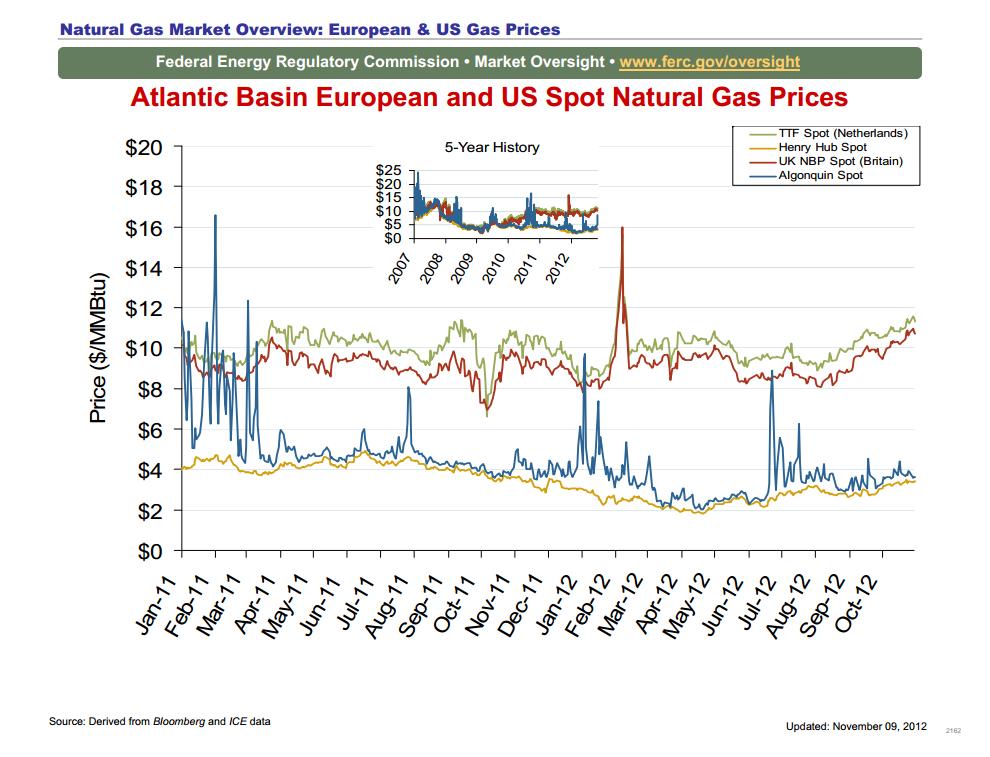
What will enhance competitiveness of the US industry will have the reverse effect in Europe which largely ignores shale gas on the ground of ecological worries. This will represent a competitive disadvantage to Europe not only in term of price but also independence, since Europe largely relies on non-EU supplies.

When enlarging the picture, the map shows that the US competitive advantage goes well beyond Europe: other countries are paying 3 to 4 times the US price.
Finally, the competition between energy sources had a direct impact on crude oil in the US. The gap between the Brent and WTI started to widen two years ago to reach a 20% price advantage today, not petty money.

Source:

Federal Reserve Bank of St Louis: Economic Research
http://research.stlouisfed.org/
Federal Energy Regulatory Commission: Natural Gas Markets
http://www.ferc.gov/market-oversight/mkt-gas/overview.asp
Wall Street Journal: Why Europe’s Banks Trail in Deleveraging Process
http://online.wsj.com/article/SB10001424052702303816504577303582094739676.html
Live Wall Street Journal: European Banks Still Hoarding Money
http://live.wsj.com/video/european-banks-still-hoarding-money/798ED78D-6CA2-442D-A41B-54FA9CB860A9.html?mod=wsj_article_tboleft#!798ED78D-6CA2-442D-A41B-54FA9CB860A9
Penn State University: The Economic Impacts of the Pennsylvania Marcellus Shale Natural Gas Play: An Update
http://www.anga.us/media/41077/penn%20state%20marcellus%20study.pdf
HIS: The Economic and Employment Contributions of hale Gas in the US
http://www.ihs.com/images/Shale_Gas_Economic_Impact_mar2012.pdf
PWC: Shale Gs – A renaissance in US manufacturing?
http://www.pwc.com/en_US/us/industrial-products/assets/pwc-shale-gas-us-manufacturing-renaissance.pdf

17 October 2012

Europe wins the Peace Noble Prize: a farce!


After Obama in 2009, a new farce, the Peace Nobel Prize is attributed to the European Union which “for over six decades contributed to the advancement of peace and reconciliation, democracy and human rights in Europe”

Whilst nobody disputes that countries within the EU are still democracies, it is a different story for the EU where decision making is undemocratic and at best opaque, the European Parliament having nearly no power, and in any case all its members but a small minority are led by the EU integrationist dogma which does not accept any contradiction and debate about the construction of the EU.

Referenda are very rarely held to ask the opinion of the European population about major Treaties which take away local democracy to a central unelected bureaucracy in Brussels led by an apparatchik-like elite disconnected from the real world.

“The stabilizing part played by the EU has helped to transform most of Europe from a continent of war to a continent of peace

This is a travesty of the truth:

There have been no war in Western Europe since WWII thanks to the reconciliation between France and Germany, between two statesmen -General de Gaulle and Chancellor Adenauer-, statesmen that the EU has been lacking for a good 40 years while gathering plenty of shortsighted politicians whose sole horizon is the next election. This low quality politic class is unfortunately shared by the US.

Beyond this, peace was ensured thanks to the US nuclear umbrella and NATO that resulted in a power balance with the USRR and it Varsaw Pact allies might.

In terms of maintaining or advancing peace, one can be doubtful about the EU capability, or even willingness, when analyzing its failure during the war in the former Yugoslavia in the 1990’s, closing a prude eye in front of massacres (remember that at the beginning of the Yugoslavian disintegration the EU –and the US- supported the central power in Belgrade). Today nothing would change.

The Peace Noble Prize has always a political message. My reading for 2012 is the following: “To the European population, further EU social, fiscal and economic integration with more taxes and power centralized to Brussels is the only way forward to get you out of the economic, financial and social mess you are in. To the Scotts, Flemish, Catalans, Lombards, etc. do not break away from your country; solidarity from richer to poorest regions is the only option, whatever the origin of the gap.” 

The subliminal message is to frighten the population on the risk of an intra-European war following a return to a nationalistic agenda of the pre WWII. This is utter fallacy. Good governance, more research, better education, less bureaucracy, better tax regime, more working hours, late retirement, etc. is the only way forward for an over indebted region entering a recession, with a banking system living on the ECB lifeline.

Source:

The Nobel prize Organization

28 August 2012

Current account surplus is a key determinant to bonds market turnaround: Italy’s case


I am reproducing in extenso a market view published bay Horseman Capital which deals with the importance of current account in assessing the ability of a country to return to good fortune, i.e. when the bond market is turning around. In a previous review published in October 2011, Rusell Clark made a good case that returning to a current account surplus is key to the turning point in bond markets.

This espouses my views about France being the real sick man of Europe as exemplified by the graphs below (and see http://marketsandbeyond.blogspot.com/2011/10/who-should-be-single-rated-italy-or.html):
Let’s now read what Russell Clark has to tell us about current accounts, Italy and the bond market.
“Sovereign Debt – Italy
In my last note on Sovereign debt – sent out in October 2011 – I noted that in all the debt crises that I have looked at, the turning point occurs when the troubled country can turn its current account deficit into surplus. I noted that of the distressed peripheral countries in Europe only Ireland had achieved current account surplus, and hence we were buyers of Irish bonds.
Since then Irish bonds have recovered most of their losses of 2011, and the Irish government has been able to return to the bond market. This is during a period of sustained instability in the far bigger bond markets of Spain and Italy.
Italy
Italy has one of the biggest bond markets in the world, and financial commentators quite rightly point out that its size means that it would be difficult if not impossible to implement the same programs that have been used by the European authorities in Portugal, Ireland and Greece. Hence, in my view the future of the Italian bond market is probably a key determinant of the survival of the Euro in its current form.
Like the other troubled nations of Europe, Italy has been running a current account deficit for a prolonged period of time. There have been recent signs of improvement, but not enough to move Italy to a current account surplus. The Economist estimates that Italy will run a 2.4% current account deficit for 2012.
However, beneath the slowly improving current account numbers, Italy’s bilateral trade numbers are showing signs of big improvements. Italy has shown a dramatic improvement in its trade deficit with China, the EU and the US.
If Italy has improved the trade positions with three biggest economic regions of the world, why have we not seen better improvement in the Italian current account? The answer is apparent when we look at the break down of Italian trade by category. As can be seen below, Italy has improved its manufacturing trade balance significantly, but all the gains in this area have been lost due to increasing commodity (mainly energy) trade deficit.
Should we see lower energy costs, I believe we would see a significant fall in the Italian current account, potentially pushing Italy to a current account surplus. For investors looking to play lower commodity prices via a long position in fixed income, Italian bonds look attractive in my view.
Almost all of Italy’s energy needs are priced off the Brent oil price. In 2008, all energy sources were comparably priced, but since then we have seen large divergences, which have put Italy at a disadvantage. Should we see a convergence in energy prices, Italy should be a relative winner, and Italian bonds should also prove to be relative winners.”
Source:
Horseman Capital: Russell Clark – Market Views August 2012
www.horsemancapital.com
Trading Economics
http://www.tradingeconomics.com

Markets & Beyond: Who should be single A rated: Italy or France?

http://marketsandbeyond.blogspot.com/2011/10/who-should-be-single-rated-italy-or.html


17 August 2012

Greece: August 20 will not be the day of reckoning


After The ECB rejected a proposal by Greece to delay 1 month a EUR 3.2 bn bond repayment, Athens issued EUR 5 bn worth of 13 wk T-Bills August 14, including non-competitive bids, which was bought by local banks on a meager 1.36 x cover ratio (the worst to date) which really shows that even short term financing is becoming difficult. These banks will probably use the T-Bills as collateral with the Greek central bank to access its emergency liquidity assistance (ELA).
Below is the current schedule of T Bills redemption until year end, i.e. EUR 15.2 bn.
The situation remains most precarious. The lack tax collection, in particular due to a continued fall in the GDP y0y and to some extent persistent fraud, does not bold well for the Greek budget. The debt is again on the increase with a sharp EUR 23 bn QoQ: after investors wrote-down EUR 105 bn in March, reducing the debt to EUR 280 bn, end of June it was back above EUR 300 bn at 304 bn.
The budget execution is rather dismay, revenues being 24% behind plan for the period January-July 2012. Looking at it in more details, the PIB item is again manipulated this year in the turn EUR 1.4 bn to present an acceptable bottom line picture.
Despite the debt write-down, interest payments remain as elevated as last year but in line with the budget.
With no GDP improvement in the foreseeable future, and the troika requesting EUR 11.5 bn additional spending cuts in order to provide further financial assistance, the squeeze will continue on the population. This being said, even if Greece does not abide by its commitments, I have no doubt that they will get additional financial aid from the EZ (In my opinion the objective is until the 2013 German elections, but I doubt markets will allow it without the ECB jumping in full gear by buying EZ sovereign debt in the primary and secondary markets with no limit).

Source:
Greek Ministry of Finance: Budget Execution Bulletins

02 July 2012

Eurozone: This time is different, or is it?


Thursday, Germany lost twice against the Italians: once for the euro 2012 soccer cup semi-final and then, later during the night, when the Italian PM Monti’s (and Spanish PM Rajoy) blitzkrieg won over frau Merkel. He played tough by simply refusing to sign any agreement until Germany agreed that the eurozone must jointly back Spanish banks without Spain having to guarantee the deb.
1. The agreement
  • setting up a single European supervisory mechanism for banks under the ECB control
  • ESM allowed to directly recapitalize banks
  • Possibility for countries which are complying with common rules, recommendations and timetables, to make use of the existing EFSF/ESM instruments to stabilise markets. Financial assistance to Spain will be provided without seniority status for the financing provided by the EFSF/ESM.
  • mobilizing around 120 billion euro for growth measures:
    • A 10 billion euro increase of the capital of the European Investment Bank implying a lending capacity by 60 billion euro.
    • The other 60 billion euro comes (i) from the reallocation of unused structural funds (55 billion), and (ii) from the pilot phase of Project Bonds to be launched this summer and targeted at key initiatives in energy, transport and broad-band infrastructure (4.5 billion).
  • Adopting a Financial Transaction Tax by December
2. What’s next?
Ireland must rejoice since they now can lineup to require the same favorable treatment, which cost is put at EUR 64 billion.
European (read mostly EZ) taxpayers are on the hook thanks to the pan-EZ mutualization of the European banking sector rescue. Do not misread me, I strongly believe that for a monetary union to survive (if not thrive) the banking sector MUST have a single supervisory board and the costs must then be shared. However, we are mutualizing liabilities before having had any chance to mutualize benefits (and will probably share none, if any in the future) at nil cost for banks; in a capitalistic environment, the ones who rescue an ailing company take control: nothing near this simple and sensible criteria here… I also notice that no FDIC equivalent is set up to guarantee deposits with no limit on the number of accounts guaranteed one can hold.
The question remains: is this the first step towards the mutualization of sovereign debt? I cannot believe that Germany would carve in; if they do, the credibility of Europe would be jeopardized.
The direction towards fiscal integration is going ahead but many obstacles remain which let me think that the success is far from being certain (I am in fact very doubtful).
Fiscal union without social union will fail as the EZ failed (whatever politicians do to disguise it, it is a failure). The EU loves, and writes in many of its statements, the words “best practice”: ask the French if best practice is 67 years old retirement age, no minimal wage, 40h a week working time, etc.
What last week agreement achieved is reassuring markets for some time by reducing the amount of money Club Med countries will devote to save their ailing banking sector: Spain has gone from 100% down to 12%. Conversely, France is adding EUR 20 billion of liabilities. Remember my words for a rather long time, France is really sick economically and worse than Italy. Today, the French Audit Court is publishing a report that I will carefully read; the first comments are rather straight to the point: EUR 40 billion need to be found until end 2013 to abide by France’s commitments on deficit reduction…
Markets will however go back to the reality of the EZ: a monetary union with a widening competitiveness gap. NOTHING, I repeat nothing, of what was decided last week is addressing this gap; the EUR 120 billion to spur growth via infrastructure investments, particularly in distressed European countries, will take years to bear fruits and 1% of EZ GDP split over 5 or 10 years, with nearly nothing in 2012-2014, is not going to help them drive their way out of recession.
The core of the problem is still pending: lack of competitiveness of Southern Europe versus Northern Europe. As a matter of fact, French will never accept a 25-30% decrease in wages to become competitive again: understandably they will always prefer a currency devaluation than a salary devaluation (and no, the effects are not the same for the population concerned).
Conclusion
Yes, this time is different because Germany bent before blackmailing, but no, it is not different because the roots of the problems remain: lack of competitiveness and structural trade deficits that act as a drag on growth which is the only way out of the crisis. The necessary structural adjustments (lengthening of working hours, postponing the retirement age, reducing the share of the public sector in the economy, etc.) will only be accepted by the population if there is some form of growth. Austerity to bring public finances under control without devaluation is a death spiral – see Greece.
As reported by Bloomberg: “the EU’s two rescue funds may only amount to about 20 percent of the outstanding debt of Italy and Spain, limiting the ability to lower the nations’ borrowing costs.”, not mentioning France.
Source:
European Council 28/29 June 2012 – Conclusions
http://www.consilium.europa.eu/uedocs/cms_data/docs/pressdata/en/ec/131388.pdf
Remarks by President Herman von Rompuy following the European Council
http://www.consilium.europa.eu/uedocs/cms_Data/docs/pressdata/en/ec/131390.pdf

Bloomberg: EU Leaders Ease Debt-Crisis Rules on Spain

http://www.bloomberg.com/news/2012-06-29/eu-leaders-ease-debt-crisis-rules-for-spain-as-merkel-retreats.html

07 June 2012

To my Greek readers: The sale of gold and silver coins by the Central Bank is a rip-off


On April 30 the Greek Ministry of Finance issued a press release announcing the sale of gold and silver collector coins. It is a rip-off, so keep clear!
The calculation is as follows:
1. Gold coins
17 g / coin @ 1,615 $/oz (1 troy oz= 31.1g) = 702.58 EUR / coin (1.2565 USD / 1 EUR)
Selling price: EUR 2,100 i.e. 3 X the value of gold!!!
2. Silver coins
24 g / coin @ 29 $/oz (1 troy oz= 31.1g) = 17.81 EUR / coin (1.2565 USD / 1 EUR)
Selling price: EUR 90 i.e. 5 X the value of silver!!!!!
Please also note that the title of precious metal is on the low end at 916/1000 of gold and 925/1000 of silver.
You are better buying alternative coins quoted on the market or gold bars. For example, for EUR 2,100 you could buy a 1 oz Canadian Mapple Leaf with 999.9 / 1000 purity and get 14.1 g more gold, a better purity and still have EUR 700 to go shopping! (and I included a fat 5% broker commission).
This deal is much worse than the issue of gold and silver coins by the French Mint in April 2011…et do not tell me that that the “collector” value makes the difference!
Source:
Ministry of Finance: Press release
http://www.minfin.gr/content-api/f/binaryChannel/minfin/datastore/f5/a3/e8/f5a3e8c5477c1dfd193356144901e5120f657bec/application/pdf/ANNOUNCEMENT+75+YEARS+BoG.pdf

Markets & Beyond: The French mint issues a limited series of gold and silver coins: a rip-off!

http://marketsandbeyond.blogspot.com/2011/04/french-mint-issues-limited-series-of.html