Showing posts with label france. Show all posts

28 August 2012

Current account surplus is a key determinant to bonds market turnaround: Italy’s case


I am reproducing in extenso a market view published bay Horseman Capital which deals with the importance of current account in assessing the ability of a country to return to good fortune, i.e. when the bond market is turning around. In a previous review published in October 2011, Rusell Clark made a good case that returning to a current account surplus is key to the turning point in bond markets.

This espouses my views about France being the real sick man of Europe as exemplified by the graphs below (and see http://marketsandbeyond.blogspot.com/2011/10/who-should-be-single-rated-italy-or.html):
Let’s now read what Russell Clark has to tell us about current accounts, Italy and the bond market.
“Sovereign Debt – Italy
In my last note on Sovereign debt – sent out in October 2011 – I noted that in all the debt crises that I have looked at, the turning point occurs when the troubled country can turn its current account deficit into surplus. I noted that of the distressed peripheral countries in Europe only Ireland had achieved current account surplus, and hence we were buyers of Irish bonds.
Since then Irish bonds have recovered most of their losses of 2011, and the Irish government has been able to return to the bond market. This is during a period of sustained instability in the far bigger bond markets of Spain and Italy.
Italy
Italy has one of the biggest bond markets in the world, and financial commentators quite rightly point out that its size means that it would be difficult if not impossible to implement the same programs that have been used by the European authorities in Portugal, Ireland and Greece. Hence, in my view the future of the Italian bond market is probably a key determinant of the survival of the Euro in its current form.
Like the other troubled nations of Europe, Italy has been running a current account deficit for a prolonged period of time. There have been recent signs of improvement, but not enough to move Italy to a current account surplus. The Economist estimates that Italy will run a 2.4% current account deficit for 2012.
However, beneath the slowly improving current account numbers, Italy’s bilateral trade numbers are showing signs of big improvements. Italy has shown a dramatic improvement in its trade deficit with China, the EU and the US.
If Italy has improved the trade positions with three biggest economic regions of the world, why have we not seen better improvement in the Italian current account? The answer is apparent when we look at the break down of Italian trade by category. As can be seen below, Italy has improved its manufacturing trade balance significantly, but all the gains in this area have been lost due to increasing commodity (mainly energy) trade deficit.
Should we see lower energy costs, I believe we would see a significant fall in the Italian current account, potentially pushing Italy to a current account surplus. For investors looking to play lower commodity prices via a long position in fixed income, Italian bonds look attractive in my view.
Almost all of Italy’s energy needs are priced off the Brent oil price. In 2008, all energy sources were comparably priced, but since then we have seen large divergences, which have put Italy at a disadvantage. Should we see a convergence in energy prices, Italy should be a relative winner, and Italian bonds should also prove to be relative winners.”
Source:
Horseman Capital: Russell Clark – Market Views August 2012
www.horsemancapital.com
Trading Economics
http://www.tradingeconomics.com

Markets & Beyond: Who should be single A rated: Italy or France?

http://marketsandbeyond.blogspot.com/2011/10/who-should-be-single-rated-italy-or.html


02 July 2012

Eurozone: This time is different, or is it?


Thursday, Germany lost twice against the Italians: once for the euro 2012 soccer cup semi-final and then, later during the night, when the Italian PM Monti’s (and Spanish PM Rajoy) blitzkrieg won over frau Merkel. He played tough by simply refusing to sign any agreement until Germany agreed that the eurozone must jointly back Spanish banks without Spain having to guarantee the deb.
1. The agreement
  • setting up a single European supervisory mechanism for banks under the ECB control
  • ESM allowed to directly recapitalize banks
  • Possibility for countries which are complying with common rules, recommendations and timetables, to make use of the existing EFSF/ESM instruments to stabilise markets. Financial assistance to Spain will be provided without seniority status for the financing provided by the EFSF/ESM.
  • mobilizing around 120 billion euro for growth measures:
    • A 10 billion euro increase of the capital of the European Investment Bank implying a lending capacity by 60 billion euro.
    • The other 60 billion euro comes (i) from the reallocation of unused structural funds (55 billion), and (ii) from the pilot phase of Project Bonds to be launched this summer and targeted at key initiatives in energy, transport and broad-band infrastructure (4.5 billion).
  • Adopting a Financial Transaction Tax by December
2. What’s next?
Ireland must rejoice since they now can lineup to require the same favorable treatment, which cost is put at EUR 64 billion.
European (read mostly EZ) taxpayers are on the hook thanks to the pan-EZ mutualization of the European banking sector rescue. Do not misread me, I strongly believe that for a monetary union to survive (if not thrive) the banking sector MUST have a single supervisory board and the costs must then be shared. However, we are mutualizing liabilities before having had any chance to mutualize benefits (and will probably share none, if any in the future) at nil cost for banks; in a capitalistic environment, the ones who rescue an ailing company take control: nothing near this simple and sensible criteria here… I also notice that no FDIC equivalent is set up to guarantee deposits with no limit on the number of accounts guaranteed one can hold.
The question remains: is this the first step towards the mutualization of sovereign debt? I cannot believe that Germany would carve in; if they do, the credibility of Europe would be jeopardized.
The direction towards fiscal integration is going ahead but many obstacles remain which let me think that the success is far from being certain (I am in fact very doubtful).
Fiscal union without social union will fail as the EZ failed (whatever politicians do to disguise it, it is a failure). The EU loves, and writes in many of its statements, the words “best practice”: ask the French if best practice is 67 years old retirement age, no minimal wage, 40h a week working time, etc.
What last week agreement achieved is reassuring markets for some time by reducing the amount of money Club Med countries will devote to save their ailing banking sector: Spain has gone from 100% down to 12%. Conversely, France is adding EUR 20 billion of liabilities. Remember my words for a rather long time, France is really sick economically and worse than Italy. Today, the French Audit Court is publishing a report that I will carefully read; the first comments are rather straight to the point: EUR 40 billion need to be found until end 2013 to abide by France’s commitments on deficit reduction…
Markets will however go back to the reality of the EZ: a monetary union with a widening competitiveness gap. NOTHING, I repeat nothing, of what was decided last week is addressing this gap; the EUR 120 billion to spur growth via infrastructure investments, particularly in distressed European countries, will take years to bear fruits and 1% of EZ GDP split over 5 or 10 years, with nearly nothing in 2012-2014, is not going to help them drive their way out of recession.
The core of the problem is still pending: lack of competitiveness of Southern Europe versus Northern Europe. As a matter of fact, French will never accept a 25-30% decrease in wages to become competitive again: understandably they will always prefer a currency devaluation than a salary devaluation (and no, the effects are not the same for the population concerned).
Conclusion
Yes, this time is different because Germany bent before blackmailing, but no, it is not different because the roots of the problems remain: lack of competitiveness and structural trade deficits that act as a drag on growth which is the only way out of the crisis. The necessary structural adjustments (lengthening of working hours, postponing the retirement age, reducing the share of the public sector in the economy, etc.) will only be accepted by the population if there is some form of growth. Austerity to bring public finances under control without devaluation is a death spiral – see Greece.
As reported by Bloomberg: “the EU’s two rescue funds may only amount to about 20 percent of the outstanding debt of Italy and Spain, limiting the ability to lower the nations’ borrowing costs.”, not mentioning France.
Source:
European Council 28/29 June 2012 – Conclusions
http://www.consilium.europa.eu/uedocs/cms_data/docs/pressdata/en/ec/131388.pdf
Remarks by President Herman von Rompuy following the European Council
http://www.consilium.europa.eu/uedocs/cms_Data/docs/pressdata/en/ec/131390.pdf

Bloomberg: EU Leaders Ease Debt-Crisis Rules on Spain

http://www.bloomberg.com/news/2012-06-29/eu-leaders-ease-debt-crisis-rules-for-spain-as-merkel-retreats.html

21 May 2012

Eurozone falling chikens’ choice: internal or external devaluation?


1. An awful political background
Since the financial crisis started in 2007, 8 elections in Europe have driven incumbent parties out of business. Whether justified or not, it shows how the European population is disgruntled by a generation of politicians whose lack of courage led to the current over-indebtedness mess (N.B. voters share the responsibility by voting for the same politicians they despite now).
For a couple of years I have written that Greece could not be saved and I strongly believe that European politicians did not give a damn about Greece to solve the crisis, and were solely interested in insulating their banks from a Greek default: to succeed, (1) time needed to be garnered (hence the succession of costly bailouts) and (2) the ECB involved by buying sovereign debt from banks and extending unlimited liquidities; banks used these liquidities to buy more European sovereign debt (the 3 years EUR 1 trillion LTRO is meant (1) to provide some breezing space for deficit prone Southern European countries –France included- and (2) give a free return to banks to strengthen their balance sheet in the turn of 2-4% i.e. EUR 20-40 bn a year, a disgrace– as a side comment, none of the executives of European banks benefiting from the ECB largess should get any bonus since the profitability of banks has nothing to do with managerial acumen, and should in fact, for many of them, be bankrupt; as I have advocating for so many years banks’ executives and theirs boards should have been fired: what shareholders are waiting for?).
Greece will again go the poll in June and I do not see why results would favor a corrupt and incompetent political arena which has ruled Greece for 30 years, and all poll are giving the extreme left SIRYZA party a large lead. Despite disguised threats to the Greek electorate (80% want to remain within the EZ but with no austerity but an open check book from the Germans – they are living in Cuckoo land) from policy makers about a possible exit from the EZ (if your vote is wrong i.e. you do not abide by our integrationist rules, then it will be a disaster for you and no more money from us), the PASOK and the so-called liberals will be out of business for good, hopefully. The trick is to propose at the same time a referendum about the exit of Greece from the EZ which would end up in a rather strange situation where the majority would vote for an anti-austerity parliament and at the same time vote again the exit from the euro whilst bailouts are linked to austerity; the discussions about adding growth to austerity are fine but will not address the roots of the problem: lack of competitiveness.
After the failure of economic convergence within the EZ, we are witnessing Greece’s standard of living fast converging not with Northern Europe but with its European neighbors, Romania and Bulgaria!
For the time being, Greece got its EUR 4.2 bn rescue payment from Europe last week (add EUR 1.6 bn if the IMF disburses its part of the deal) that will cover its liquidity needs for June and probably until late July since Greece has hardly any repayment due in July.
Parliamentary elections in France, also taking place in June, will see the current Sarkozyst party (UMP) lose a considerable number of seats pending unofficial local agreements with the FN, Mrs. Le Pen populist party. The socialist party will win the elections, the question being by which margin: if their victory is large enough, after gaining control of the Senate in September 2011 for the first time under the Vth Republic, they could hold 2/3 of the congress (Senate + Parliament gathering) to modify the constitution as they wish.
Germany’s Chancellor Angela Merkel registered a strong defeat in North Rhine-Westphalia state election in May, the most populated region. However the increased lead for the SPD (the center left) does not mean that this will end the austerity imposed onto Southern Europe since it is the SPD that enshrined budget balance in the Constitution: Germans will not agree to finance ad vitam aeternam Southern Europe for the sake of “peace and the European construction”, which is the dogmatic and untrue eurocratic motto.
2. An awful economic background
Economic forecasts for 2012 and 2013 are between bad and disastrous for Club Med countries (the IMF is less confident than the EC, and private forecasters are even more pessimistic), and downward revisions will crawl along the year and next.
As the table below exemplifies, GDP will turn negative this year and more deeply so in 2013, with hardly any EU country escaping, the EZ being more affected, and within the EZ, Southern Europe the most
In the case of France, the new President, François Hollande, based his economic program on official, and as usual over-optimistic, growth forecasts of 0.7% in 2012, 1.75% in 2013 and 2% until 2016, whilst the country will be in negative territory in 2012 and 2013 at least. Add a Greek default and you get an asset that becomes a straight loss in the turn of EUR 15 bn from the first bailout already paid plus any recapitalization of the ECB.
France’s deficit will not be reduced back to the 3% Maastricht criteria in 2016 and its debt will continue on its upwards trajectory. Expect 2 notch rating downgrade within 12 months.
 Like other Europeans, the standard of living of French citizens will keep up contracting.
The key issue of low competitiveness is structural, and economic, social and tax reforms are not addressed. Policy makers have focused for too long on what they thought, incompetently or dogmatically, were liquidity issues.
3. The choice
This foolish blindness is leading to one of two tough choices: internal or external devaluation to quickly regain competitiveness.
Let’s come back to my preferred equation:
PIB = Public spending + private spending + commercial balance
The World has huge imbalances which result from demand led economies (USA for example) whose consumption is satisfied by export driven economies (China for example), and these imbalances must be corrected to go back to some economic and financial normality.
Looking at the equation, and taking into account the state of debt and budget deficits in demand driven economies in the West, they MUST shift their focus to improving their trade balance, and export driven countries MUST stimulate domestic demand.
There are two ways to improve the trade and services balance: either increase exports or reduce imports or a combination of the two.
To increase export one needs to propose goods that others want to buy by focusing on added value products (there is no way to be competitive for goods very elastic to prices) or unique goods and improve competitiveness. Wage and social costs are the items a country controls which impact productivity and no Club Med country will escape harsh austerity. Energy is also quite important and must be addressed (the USA is thriving in becoming self sufficient again in the years ahead thank to technology which allows shale oil and gas recovery – this will all also have a substantial positive impact on the US trade balance).
To reduce imports, goods must become too expensive for consumers or find the same ones locally at attractive prices. This can be achieved via custom tariff and/or other tricks or via unfavorable exchange rates.
Therefore, taking the extreme case of Greece (but it is valid for Spain, Italy, France, etc.), to rebalance the economy and improve the terms of trade, the choice is between external or internal devaluation.
External devaluation corresponds to the exit from the fixed exchange rate mechanism (the euro) where the Drachma will loose 50-70% of its new parity with the euro (or DM) leading to much higher imported goods thus lowering consumption and more importantly lowering imports; this assumes that the goods and services needed will be substituted with locally produced ones, otherwise the country will continue impoverishing itself. The terms of trade for exports will also dramatically improve, assuming Greece will produce goods other countries want to buy. For the country not to crumble under debt servicing, this will be accompanied with a debt default (restructuring, straight default, inflating the debt away, you name it). Competitive exchange rate devaluation has always been and still is an economic policy tool (see the US and China manipulating their currencies at will).
Internal devaluation is where countries have chosen austerity without currency devaluation: the only adjustable variable is real wages and social benefits which must be reduced and this must be equivalent to a currency devaluation. The terms of trade will not improve and trade imbalances will remain. Debt servicing becomes unsustainable by eating a rising portion of taxes collected. This can only work with fiscal transfers from other countries if a social collapse is to be avoided, i.e. Germany continuing paying.
Whatever the course of action followed, the standard of living of Europeans will continue to fall for years if not for a decade. However, the internal devaluation route, if followed, would end up very nastily.
I will never sufficiently outline the need for Europe to focus on innovation (strength of the US which also explains why I am more positive on the US economic prospects than the European one) and demographics, an other factor of economic growth: spending money in these areas instead of Greece et al. would have been more beneficial to European growth long term.
Source:
Capital Economics: European Economic Outlook Q2 2012
http://www.capitaleconomics.com/

26 April 2012

French Presidential Elections: First round and why it does matter


1. Results
For the first time under the Vth Republic, the incumbent President is behind his main challenger.
The official results are as follows (I do not provide the meaningless result from Jacques Cheminade):
2. Consequences
One of the central conclusions of the campaign is the rejection of the EU as it currently works and calls for increasing protectionism: even Sarkozy demands modifications to the Shengen accord and Hollande a renegotiation of the Lisbon Treaty. A quick analysis of the results show that, in one way or the other, the vast majority campaigned on a platform that will lead to a frontal shock with Germany: budget balance and austerity vs. social welfare and deficits, southern Europe vs. Northern Europe, domestic demand oriented growth vs. export oriented growth.
In addition, both Sarkozy and Hollande built their programs on an over-optimistic GDP growth forecast to cut borrowing at 0.7% in 2012, 1.75% in 2013 and 2% until 2016, well above consensus (most politicians do overstate future growth to buy votes). and neither is addressing the key issues holding back growth. For example, last week the IMF revised down 2013 French growth to 1.0%.
Whoever is elected President on May 6, he will not be able to hold by his promises. This will have a number of consequences:
  • Spread between OAT and Bund will widen
  • The eurozone will again come under strain and attack from markets (i.e. investors)
  • France will loose it AA+ and be downgraded (over a 18 months period, one notch if Sarkozy is elected, two notches if it is Hollande)
  • Expect social unrest within 12-18 months, particulalry if Sarkozy is elected
Then, the Parliamentary elections will come in June and there is no chance whatsoever that the current ruling party wins, even if Sarkozy is re-elected. The antagonism with the Front National is too entrenched and the possibility for the Front National candidates to have enough votes to remain in 1/3 of constituencies for the second round.
If Sarkozy is not elected (the likely outcome as of today since over 1/3 of Bayrou and 40% of Le Pen voters will abstain for the second round, the rest will go +/- 50/50 for each remaining candidate), I also expect the current ruling party to fall in shambles with infighting between Coppée (current Head of the ruling party - UMP) and Fillion (current Prime Minister – a senior member of UMP) each preparing for the next Presidential race in 2017 (Fillion will present himself at the mayoral election for Paris).
I then forecast the Front National to try its utmost to organize the opposition to the the socialists around its platform, with some with the right wing of the UMP joining forces with the National Front, and possibly Dupont-Aignan.

Source:
Ministère de l’Intérieur: Presidential elections 2012
http://elections.interieur.gouv.fr/PR2012/FE.html
Ministère des Finances: Stratégie Pluriannuelle de Finances Publiques
http://www.budget.gouv.fr/files/mise-a-jour-rapport-economique-social-financier.pdf
Capital Economics: French election won’t tackle key issues
www.capitaleconomics.com

02 April 2012

Stop Press: Markit Eurozone Manufacturing PMI – It’s really bad


I usually do not post this kind of economic data, since there are so many published every week. I am doing so since the numbers are striking, France in particular is a real disaster. As I indicated many time, forget about Portugal, Spain (well not really, do not forget Spain!) and Italy, France is the sick man.
Greece: 3 month high but still in contraction territory @ 41.3
France: 33 month low (yes, you read it right!) @ 46.7 (I heard on the French radio that the 2 French auto-manufacturers – Renault and Peugeot – had sales 30% down in March; the French auto industry, Peugeot in particular, is entering the danger zone for its survival).

The roots of the problem have not been addressed, and politicians are still in denial territory: the construction of Europe for the past 20 years is a failure due to a dogmatic approach.
Source:
Markit:  Markit Eurozone Manufacturing PMI® – final data
http://www.markiteconomics.com/MarkitFiles/Pages/ViewPressRelease.aspx?ID=9330

28 February 2012

French capitalism = socialist cronyism


On February 20 the French financial newspaper, Les Echos, announced that Mr Proglio, former CEO of Veolia, the world leading environment company, now CEO of EDF (one of the world largest electricity companies), designed a plot to oust the current CEO, Mr Frerot who has been trying to sort out the mess left by Mr Proglio, still a Director of Veolia. His replacement was meant to be Mr Borloo, former Minister in the Sarkozy Government until last summer (when he was not nominated Prime Minister), and candidate for the Presidency who unexpectedly dropped out of the race a few weeks ago to support President Sarkozy… Please note that Mr Poglio was strongly promoted by Sarkozy to arrive at the helm of EDF.
This is typical of political cronyism which looks more like what is witnessed in banana republics than in a so called developed democratic country.
France has never ever been economically liberal despite what is said on media, in political circles or with outdated unions (few remember that during the early 70’s the French Stalinist communist party was gathering around 23% of votes!). France has always been a centralized country since the affirmation of the absolute monarchy with Louis the XIV during the 17th Century; such centralization might work when the ruler at the helm is able, otherwise you run to disaster: unfortunately for France, since General de Gaule (i.e. for the past 40 years), France has never been ruled by a statesman but by politicians of varying quality (generally average to low), always with a socialistic agenda. Since the Mid-90s, cronyism has developed at a fast pace which has been detrimental to French citizens well-being.
Mr Proglio is unfortunately not due to renewal as a Director of Veolia until 2014. I invite all shareholders of this company to draw a line in their agenda for 2014 and vote against his re-appointment (if he is a candidate indeed).
Please note that EDF share price lost 50% since Mr Proglio took over EDF as CEO.
Source:
Bloomberg: Veolia Falls After Les Echos Says CEO Frerot May Be Replaced: Paris Mover
http://www.bloomberg.com/news/2012-02-20/veolia-falls-after-les-echos-says-ceo-frerot-may-be-replaced-paris-mover.html

03 November 2011

Eurozone as we have known it: end of story

1. Greece

Tuesday’s announcement by the Greek Prime Minister, Giorgios Papandreou, of an impeding referendum on the second rescue package concluded a few days before sent market rolling and policy makers tangling in despair and frustration.

It was doubtful that this rescue package would work, but at least it was buying (wasting) a bit more time.

Interesting enough Wednesday’s evening discussion between Merkel, Sarkozy and Papandreou ended up for the first by mentioning the exit of euro for Greece if Greeks vote no to the rescue package, which so far was dumb impossible… As I wrote to JC Juncker in July, Europe lacks credibility and its first task should be to reinstate it: For 2 years, the opposite way has been followed by a succession of denials and scapegoating.

If I were Greek, I would go straight away to my bank and get all my cash to hide it under the mattress; so, expect a run on Greek banks that are bankrupted anyway with their load of junk Greek sovereign debt.

November-December 2011 debt redemption schedule:
11 November: EUR 2 bn (26 wk T bills) + 49 mio interest
18 November: EUR 1.6 bn (13 wk T bills) + 18 mio interest
12 December: EUR 2 bn (26 wk T bills) + 50 mio interest

23 December: EUR 2 bn (13 wk T bills) + 46 mio interest

According to Papandreou, Greece has enough money to survive until mi-December, so just after the referendum due to take place 4th December.

Well, if there is a referendum (there are rumors it would be called off; what a farce!!): Papandreou called a vote of confidence for Friday; if he does not win then new elections would be called and the referendum becomes history. The EU and IMF would provide Greece with its EUR 8 bn 6th tranche from the first EUR 110 bn rescue package.
Alternatively a Government of national union could be formed with the opposition. This would be the best outcome for the EZ and the euro.

2. Italy

Friday’s bond auction witnessed an interest rate increase to 6% (so before Papandreou referendum announcement) and since, borrowing costs have reached a record high (10 year bonds reached a high of 6.399% today), not seen before the creation of the euro. The cost of debt is not sustainable.

Wednesday evening Berlusconi could not get cabinet approval when his Northern League ally refused to increase the retirement age from 65 to 67 years as demanded by Merkel-Sarkozy for the G20 meeting in Cannes, which castes doubts about Italy’s ability to implement unpopular measure to reduce its (slowly) mounting debt.
Whilst Italy’s economic situation is on many indicator much less worse than France’s, its weak political system, large legacy debt and slow growth are making the country the target of markets.
France is however not far behind.

3. France

On many indicators, France is in a worse situation of Italy: debt increase (will soon catch up Italy), primary budget deficit, trade balance and unemployment.

The 2012 budget is based on a 1.75% real GDP growth that will not be reached: the consensus stands at 0.9%. This means finding EUR8-9 bn to maintain the objective of deficit reduction down to 4.7% in 2012 and 3% in 2013. However, most of the rumored measures are in the form of tax increase and not economies. Yet with the previous EUR11 bn deficit reduction announced a few weeks ago, EUR1 bn was made of cost cutting whilst EUR10 bn were tax increases. France has always the tendency to increase taxes instead of reining in it overload civil service (in particular with local authorities which has boomed for the past 10-15 years).
Markets are taking notice and spreads with Bunds have trebled since early July:
France is next in line (together with Belgium) and is at risk of loosing (should loose) it AAA rating which is the cornerstone of the EFSF together with Germany’s AAA. Any downgrade will pressure rates at which the EFSF borrows ; yet, Wednesday, the EFSF had to postpone a EUR3 bn bond issue schedule in the next fortnight and 10 yr spread over German Bunds increased to 1.5% from 0.7% in September.

The current crisis exemplified, if needed to be convinced, that the construction of the EU and EZ is a Franco-German affair. Whilst Germany is clearly in the driving seat (in the end who gets the money decides), there still is an appearance of equality between the two countries: would France loose its AAA, this balance would be shattered and Germany could, politely, pursue its own interest, eastwards…

Conclusion

France is the hidden weak link of core EZ and this begins to appear openly. I very much doubt that France will be able to abide by its budget deficit forecast without number muddling (France can always call on the CDC – a large French state-owned financial institution- to get a couple of billions euros).

After this crisis, the EZ cannot be the same: the way it works, decisions taken, budgets voted, Maastricht criteria respected (or even more stringent ones: no budget deficit), money spent, will make the EZ, if it survives, a different planet. Even its perimeter can be challenged. I still believe that a narrower EZ with a euro DM is a possible outcome: the question is, would France be part of it?
Anyway, Europe will be German or will not be.
03 Novemberg 2011

Source:

Bloomberg: Europe’s Financial Crisis Deepens as Greek Government Teeters


http://www.bloomberg.com/news/2011-11-03/europe-s-financial-crisis-dominates-g-20-talks-as-greek-government-teeters.html

Bloomberg: Berlusconi Arrives at G-20 ‘Empty-Handed’ After Vowing Economic Overhaul


http://www.bloomberg.com/news/2011-11-03/berlusconi-arrives-at-g-20-empty-handed-after-vowing-revamp.html

Financial Times: EFSF postpones €3bn bond issue


http://www.ft.com/cms/s/0/47f3998e-0546-11e1-a3d1-00144feabdc0.html#axzz1cdb7yxNB

26 October 2011

European banks’ recapitalization

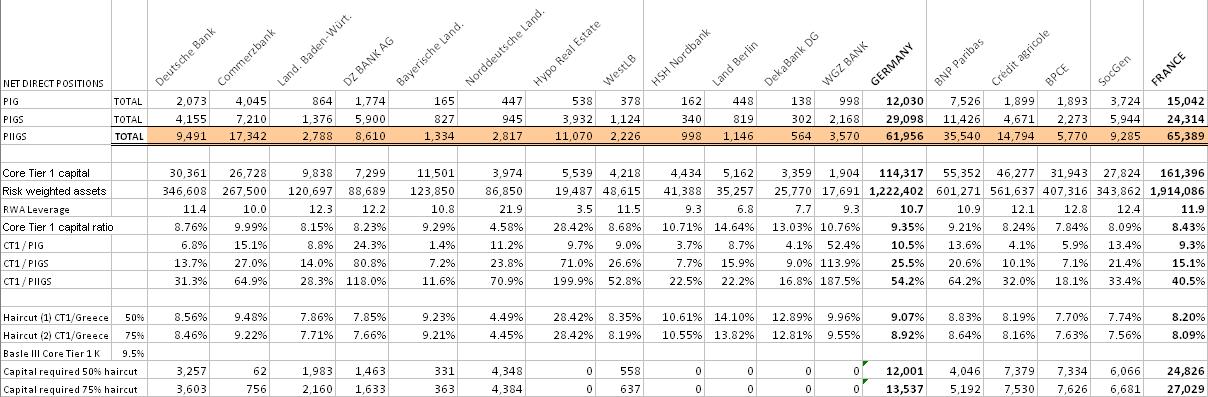
When the EBA stress tests on 90 European banks were published in July, I titled them a mockery. I conducted my own analysis according to a 50% and 75% haircut on sovereign debt in PIIGS countries to abide by the 9.5% core capital to be reached by 2019 according to Basle III rules (many banks said they would get there well ahead of time): this analysis produced the numbers I mentioned in several articles on this blog.
In the table below, let’s look at German and French banks’ exposure to the Greek sovereign debt (being the main holders, I do not include other banks):
A 50-75% Greek default would result EUR 36 and 40 billion new capital required, split 1/3 for Germany and 2/3 for France. This does neither take into account their exposure to the banking and private sector nor guarantees/commitments/derivatives (including CDS). The German situation is not much worse with respectively EUR 9.7 billion additional exposure (including EUR 2.1 billion with Greek banks) and EUR 5.3 billion; French banks’ are in a much more difficult position with EUR 43.5 billion (including EUR 1.6 billion for banks) and EUR 8.3 billion.
To be fair, these numbers reflect the situation at the end of December 2010 and French banks have significantly reduced their exposure on their Greek sovereign debt during H1 2011: BNP Paribas from EUR 5 billion to EUR 3.5 billion and Société Générale from EUR 2.7 to EUR 1.9 whilst producing a net 6 months result of EUR 4.7 billion and EUR 1.6 billion, so enough to absorb a 100% default. However, as for Dexia that went under mainly because of its exposure to the non-sovereign credit book, I do not know what the quality of the private book is.
Let’s add a 100% default on Greek banks and 15 % on the private sector (guarantees and commitments included but not derivatives), the banking needs required to abide by Basle III rules is north of EUR 50 billion for German and French banks that were subject to the EBA stress test.
The total number of EUR 100 billion rumored to be in the starting blocks to recapitalize European banks is probably right on a Greek basis alone. In order to weigh the minimum possible on government budgets already under dramatic strain, this recapitalization should be undertaken via profits, cutting dividends to zero and reducing bonus payments (say by the same amount as the Greek default). It is however far from addressing the rest of BIGSPIF sovereign risk.
Nevertheless, the EUR 100 capitalization does not address the core of the matter: the sovereign insolvency and lack of economic competitiveness. More on this in a forthcoming article: France - EZ weak link.
BIGSPIF = Belgium, Ireland, Greece, Spain, Portugal, Italy, France

09 October 2011

Who should be single A rated: Italy or France?


I am amazed that France rating has not been downgraded as yet: it does not deserve a AAA by a long margin.

First, have a look at current rating for European countries (please note that since this table was published, Moody’s downgraded Italy 3 notch to A2 from Aa2, i.e. the same as Poland or Cyprus). This downgrade is probably justified in itself, but I am questioning how France can retain the top rating.
From data published by the OECD in May and the IMF in September, France is in a worse shape than Italy according to many indicators.

1. Debt/GDP

If the debt/GDP is the Achilles heel to Italy, its growth is nowhere comparable to France’s which is catching up quickly: +6% for Italy for the period 2000-2012 and +52% for France.
2. Real DGP growth

France is much better off with GDP growth twice the pace of Italy during 2000-2012 at 1.5%. French growth is however mainly due to domestic consumption spurred by the state welfare that France can no longer afford.
3. General Government Financial Balances

The French welfare state largess translated into higher budget deficits whatever the Government (France hasn’t had any balanced budget since 1978): the Maastricht 3% deficit ceiling was respected only 4 times since 2000, France doing much worse than the eurozone average since 2008 (-5.9% vs. -4.6%); - Italy fared better with -4.1%.
Analyzing further the budget, the situation looks even much worse for France: its primary budget balance has been negative for 10 years whilst Italy had always been positive (note that Italy’s primary budget is even much better than Germany). The IMF does not expect France’s primary budget to become positive before 2015.
4. Trade balance (goods & services)

This indicator is not helping out France’s precarious position, to the contrary. Since 2005 France has experienced increasing trade deficits, together with Italy but with an incomparable magnitude: USD 489 billion cumulated, 2.3 times more than Italy; Germany in the meantime accumulated a USD 1550 billion surplus. In percentage of GDP the analysis is the same.

True France enjoys a net investment income whilst Italy is negative, which translates into a comparably better current account for France.
5. Unemployment rate

Unemployment is another indicator where France is not comparing well with Italy, underperforming since 2003.
Conclusion

France does not deserve the top rating with the three main rating agencies (by the way, when European politicians accuse these agencies of an American plot against Europe, beyond being a “scapegoating” affirmation, they should remember that Fitch belongs to a French company, Fimalat).
According to the indicators presented, France should hardly be better rated than Italy.

Add guarantees to be given by France for Dexia’s failure (where France should bear most of the burden since most of the problem arises from Dexia CLF - the French part of the group with 259 x leverage!) and I do not see how and why France will keep its AAA. Belgium is under watch for possible downgrade following Dexia’s bankruptcy. It is also quite “funny” to watch France arm twisting Belgium to bear most of the burden in order to keep its AAA (that it will loose anyway): how guarantees for the EUR 95 billion impaired portfolio will be shared (EUR 66 billion in Dexia CLF balance sheet)…

The “funniest” of all is that Dexia CLF is going back to CDC (the French state owned financing vehicule) where it originally came from under the name of CAECL. From privatization to nationalization, 20 year of incompetent board of directors that let an incompetent management expand all around the world into risky businesses without the means (read capital) of their ambitions.

Please note that I do not blame the new management that arrived after the 2008 rescue since Dexia was doomed: there was not much they could do, and they probably did what they could with the legacy they got.

Source:

WSJ: S&P Cuts Italy's Sovereign-Debt Rating


http://online.wsj.com/article/SB10001424053111904106704576581301721363640.html

IMF: World Economic and Financial Surveys

http://www.imf.org/external/pubs/ft/fm/2011/02/pdf/fm1102.pdf


© Markets & Beyond
 
OECD: OECD Economic Outlook No. 89


http://www.oecd.org/document/61/0,3746,en_2649_34573_2483901_1_1_1_1,00&&en-USS_01DBC.html


Markets & Beyond: Dexia in 2 slides and a few words

http://marketsandbeyond.blogspot.com/2011/10/dexia-in-2-slides-and-few-words.html