Showing posts with label PIIGS. Show all posts

26 October 2011

European banks’ recapitalization

When the EBA stress tests on 90 European banks were published in July, I titled them a mockery. I conducted my own analysis according to a 50% and 75% haircut on sovereign debt in PIIGS countries to abide by the 9.5% core capital to be reached by 2019 according to Basle III rules (many banks said they would get there well ahead of time): this analysis produced the numbers I mentioned in several articles on this blog.
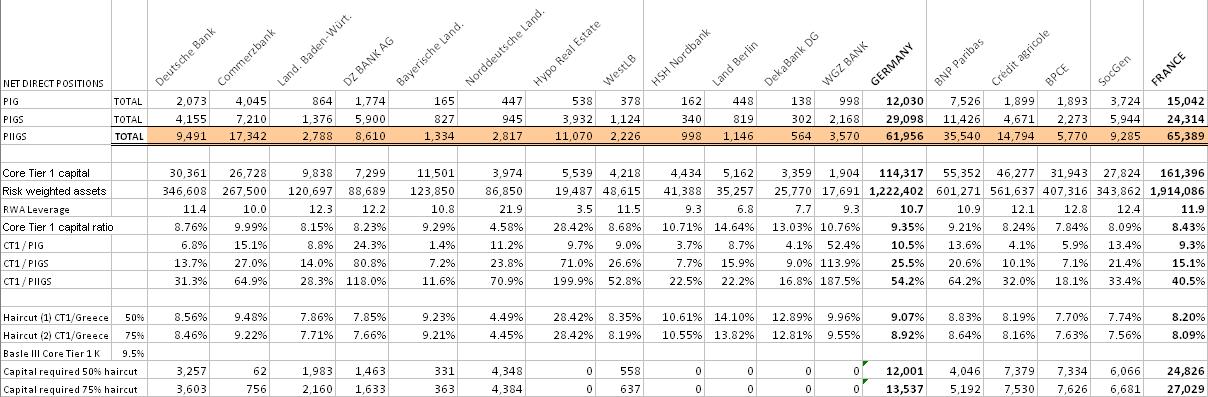
In the table below, let’s look at German and French banks’ exposure to the Greek sovereign debt (being the main holders, I do not include other banks):
A 50-75% Greek default would result EUR 36 and 40 billion new capital required, split 1/3 for Germany and 2/3 for France. This does neither take into account their exposure to the banking and private sector nor guarantees/commitments/derivatives (including CDS). The German situation is not much worse with respectively EUR 9.7 billion additional exposure (including EUR 2.1 billion with Greek banks) and EUR 5.3 billion; French banks’ are in a much more difficult position with EUR 43.5 billion (including EUR 1.6 billion for banks) and EUR 8.3 billion.
To be fair, these numbers reflect the situation at the end of December 2010 and French banks have significantly reduced their exposure on their Greek sovereign debt during H1 2011: BNP Paribas from EUR 5 billion to EUR 3.5 billion and Société Générale from EUR 2.7 to EUR 1.9 whilst producing a net 6 months result of EUR 4.7 billion and EUR 1.6 billion, so enough to absorb a 100% default. However, as for Dexia that went under mainly because of its exposure to the non-sovereign credit book, I do not know what the quality of the private book is.
Let’s add a 100% default on Greek banks and 15 % on the private sector (guarantees and commitments included but not derivatives), the banking needs required to abide by Basle III rules is north of EUR 50 billion for German and French banks that were subject to the EBA stress test.
The total number of EUR 100 billion rumored to be in the starting blocks to recapitalize European banks is probably right on a Greek basis alone. In order to weigh the minimum possible on government budgets already under dramatic strain, this recapitalization should be undertaken via profits, cutting dividends to zero and reducing bonus payments (say by the same amount as the Greek default). It is however far from addressing the rest of BIGSPIF sovereign risk.
Nevertheless, the EUR 100 capitalization does not address the core of the matter: the sovereign insolvency and lack of economic competitiveness. More on this in a forthcoming article: France - EZ weak link.
BIGSPIF = Belgium, Ireland, Greece, Spain, Portugal, Italy, France

14 September 2011

Greece’s race to default and European Banks’ recapitalization


What I wrote 18 moths ago is unfolding and Greece is racing toward default and policy makers must decide who will bear the burden: taxpayers by continuing extending credit lines and the ECB buying sovereign debt in the secondary market to artificially maintain low interest rates and allow banks to offload their junk assets, or the private sector by recapitalizing banks - bondholders taking an haircut.
European banks’ share prices are nearing their lowest since the nadir of the financial crisis in 2008-2009, and French banks are now over 50% down compared to their 2011 high and counting. According to Bloomberg, European banks are trading at 0.58 X book value, indicating that there is not much trust in the value of their assets.
1. Greece
Greece is asked to deepen its austerity measures in a self-fulfilling downward GPD spiral (and lower tax receipts) that will lead to a full-blown depression for Greeks together with  social unrest, and possibly a threat to democracy when the population will become so desperate it will take desperate actions (and what will happen to Greece can occur elsewhere in Europe). Greece needs economic growth to fulfill its commitments and austerity without devaluation is just a death kiss.
GDP growth was downgraded in September to -5.3% in 2011 (-3.5% forecasted by the EU in May) and these GDP numbers were helped by a plunge in the trade deficit (not surprising for a country entering into depression). The HCPI is flat from January to August but is sharply down in July and August. I have stopped assessing the impact of continuing downgrades and a worsening situation; my last calculation early September was a EUR 29 billion deficit for 2011 (EUR 19 billion in the Greek budget), 160% debt/GDP and 13% deficit/GDP at the end of the year.
I do not see how Greece could even issue 13 and 26 weeks bills, the more at acceptable yields, with EUR 2 billion due on each of October 14 and 21; add interest payments plus deficit to plug and a default is there by end of October or at the latest end of November where EUR 5.6 billion of debt are coming due (Greece has still a bit of cash at the Treasury plus could ask the Central bank to sell some gold or pay an exceptional interim dividend or any other form of transfer). In addition, at the end of July, Greece had EUR 6.5 billion in arrears to third parties… Greece’s CDS are pricing de 98% risk of default.
On Monday, Greece’s bond yields reached a record with the 1 year at 110%, 2 year at 63% and 10 year at 21% which just tells you the story: at these levels it is meaningless; Greece is bankrupt and European leaders have failed their mandate so far whilst they have a fiduciary duty to defend their citizens and must restructure unserviceable sovereign debt. Numbers from the EBA show that financial institutions as a whole can sustain such a restructuring with a haircut of 50% (even 75% is workable). For the banks that need to raise equity/dispose of assets where existing shareholders and bondholders do not act, their ownership will be transferred to a more competent stewardship, existing shareholder being wiped out and bondholder paying the price for bad investments. This would most probably translate into larger deficits which would be better accepted by markets since we would have seen the trough of this crisis and, hopefully, sound foundations would have been laid down.
In any case, but for a massive fiscal transfer which is most unlikely, I expect the standard of living of Greeks to go down anywhere between 40 and 50% over the next few years.
It strikes me that instead of pouring money at Greece et al, it would be better for European Government to recapitalize banks if the private sector is falling to do so; yes, this would end up nationalizing some banks, so what? Temporary nationalizations would be preferable (with the firing of boards and management) than a rampant crisis that will not be solved adequately by throwing good money after bad.
2. Banks
Following, a recent article published on Markets & Beyond where I analyzed banks’ risk on a PIIGS’s sovereign default, I found a few estimates concerning the need for recapitalizing European banks ranging from EUR 200 billion (IMF - before a downward revision after a EU complaint – sic!) to EUR 1 trillion (Goldman Sachs – they talk their own book) in order to cover all Bank’s write-downs, and not only sovereign debt.
Crédit Agricole and Société Générale ratings were downgraded this morning with negative outlook, and BNP Paribas will probably follow: they will cut assets to boost capital ratios, the deleveraging process has much more to go. Most spreads are increasing, some dramatically, at a time where their access to short term financing is cut by some large money market funds: share prices are 50%+ down since the high of the year, French banks being particularly hit (I repeat once again that Italian banks as a whole have a meaningless exposure to PIGS and are less risky than French ones– they are hit because of their holding of Italian sovereign debt but I do not believe that Italy will default). I have written several times that France is in a worse situation than Italy I many ways.
The sharply increasing cost of financing for many banks is not sustainable beyond the short term and will start soon to fuel through the real economy weighting further on a dismayed European growth. Some will see their access to the interbank market closed, if not already occurring.
On Monday, Dexia CDS spread shoot up to 1569 basis points at mid-day (+225 b.p.), worse than Portugal and Venezuela: this is just telling what the market thinks about the quality of Dexia asset portfolio and exposure to local authorities and municipalities debt (do not forget that Dexia was the largest foreign borrower with the FED during the 2008-2009 financial crisis); its exposure to Greece sovereign debt is the worst of any bank surveyed by the EBA but BNP Paribas (yes, worse than Commerzbank!), with a  total exposure to PIGS (sovereign, banks and other private sector) standing at EUR 43.9 billion (EUR 10.6 billion excluding Spain) according to the numbers published by the EBA: Dexia has EUR 17 billion of core capita, enough to absorb a Greek default, private sector included (and a Portuguese one – no exposure to Ireland). However, Dexia could not sustain a collapse of banks in Spain with a EUR 23.6 billion exposure. I also guess that the interbank market is closed to Dexia.
The OTC derivatives, CDS in particular, represent the last frontier concerning risk. I have not read anywhere sensible information about who owes and who owns what to/from who, so it is impossible to figure out who is at risk and for the owners of CDS what is their counterparty ability to fulfill their commitments. This really is a black hole.
A few last words:
  • During the weekend, there was rumors that Germany was preparing for a Greek default (50% haircut – it maybe more up to 75% in my opinion) and plan B was design to shore up/save German banks from a collapse (I guess via a recapitalization). Germans are sensible people (like Finns).  Those who do not survive will be bailed out, but shareholders and bondholders would take the first hit this time, at last.
  • European banks volunteered for a 21% haircut, which would be a very good deal for them since the Greek debt is trading at much lower prices in the market. It is worth mentioning that some do not believe that their losses would be limited to that number (RBS provisioned 50%). I doubt it is a good deal for Greece.
  • RWA with zero allocation for sovereign risk is non-sense. There are insisting discussions/rumors that Basle III would be toned down in order to avoid a collapse in banks lending and increase in the cost of financing: this is again an efficient lobbying by banks but pure bullshit (see conclusion).
  • The ban on short selling to avoid the so-call (ugly) speculators to drive financial stocks down demonstrated that “proper” investors are driving them sharply down.
  • Since the financial crisis was triggered in August 2007, the strategy followed has been to concentrate risk instead of a largely mutualizing it, i.e. shareholders and bondholders bearing most if not all the cost of wrong investments/governance and leaving both complacent/incompetent Boards and greedy Management at the helm of now endangered financial institutions. This strategy was wrong.
  • Bank of England Chief Economist John Vickers has recommended the separation of banks’ consumer and investment banking activities: this is going in the right direction (in fact back to the period before the “Big Bang” in the late eighties)
  • Board of directors should be accountable before courts and pay-back all remunerations received since the trigger of the financial crisis in 2007; they should also not to be able to hold any directorships in the future as well as serve a suspended jail sentence (say one week) to make the point: it is really time to name and shame.
Conclusion
Banks can survive a PIGS default on a sovereign basis with existing shareholders’ funds. When taking into account the exposure to the private and inter-banking sectors, Spain might be a different story with debts due to banks in the Europe totalizing USD 568 billion and who knows how much of the private sector assets are at risk. Italy would be a game changer. So the crisis needs to be contained to the PIG; this could have done at a much lower cost in 2009 and 2010 and the spill over risk was much more limited.
It is most likely that the ECB will step up it purchase of Italian and Spanish (and Belgium and French) debt since this is the only viable European institution which can on the spot respond to the debt situation and expand its balance sheet quasi-indefinitely by printing money. It is also most probable that this over-indebtedness will be resolved via inflation as usual (at 5% per annum – an inflation rate perfectly sustainable - over 5 years 22% of principal are wiped out and 39% over 10 years).
Please, beware of lobbying by the financial sector: Empirical evidence doe not support the affirmation that much higher levels of equity funding, and less debt, would mean that banks’ funding costs would be much higher. A recent Bank of England report concludes:
“In retrospect we believe a huge mistake was made in letting banks come to have much less equity funding – certainly relative to un-weighted assets – than was normal in earlier times…We believe the results reported here show that there is a need to break out of the way of thinking that leads to the “equity is scarce and expensive” conclusion. That would help us get to a situation where it will be normal to have banks finance a much higher proportion of their lending with equity than had been assumed in recent decades to be acceptable. And that change would be a return to a position that served our economic development rather well, rather than a leap into the unknown.”
We must also go back to the roots of capitalism where success is rewarded and failure is sanctioned otherwise success is meaningless, and success needs to be clearly redefine to adequately reward it.
It is also time for a new generation of politicians (I am not discussing age but attitude) to replace our failed leaders who share the responsibility of the mess we are in, at best by incompetence and sheer populism, at worse by complicity: democracy as we have known it is at stake. The eurozone creation was “sold” to the public as a mere unified forex zone where tourism would be easier and inflation checked (a lie), and never as a monetary union that demanded homogenization among participating countries on a social and fiscal basis. Under the current structure and membership the eurozone is a failure: a structural change or a different geographical perimeter is required.
Credibility and psychology are key and European leaders lacked both, hence the absence of confidence by markets and European citizens. This needs to be redressed, urgently.Finally, a word from Romano Prodi, EU Commission President, in December 2001:
“I am sure the Euro will oblige us to introduce a new set of economic policy instruments. It is politically impossible to propose that now. But some day there will be a crisis and new instruments will be created.”
Source:
Bank of England: Optimal bank capital
http://www.bankofengland.co.uk/publications/externalmpcpapers/extmpcpaper0031.pdf
Bloomberg: Europe Banks Valued at Post-Lehman Low
http://www.bloomberg.com/news/2011-09-11/europe-banks-at-post-lehman-lows-show-sovereign-risks-escalating.html
Greece Ministry of Finance: General Government Monthly Cash Data and Arrears
http://www.minfin.gr/content-api/f/binaryChannel/minfin/datastore/ec/24/33/ec24332a7c775c1d903893a03dcc52be7bdf10b3/application/pdf/general+government+data+7month+2011.pdf
Hellenic Statistical Authority
http://www.statistics.gr/portal/page/portal/ESYE
UBS Investment Research: Euro break-up – the consequences
Goldman Sachs: Banks as bystanders at the sovereign stage of the crisis
Bloomberg: Britain to Implement Vickers’ Bank Protection Plan by 2019
http://www.bloomberg.com/news/2011-09-12/u-k-banks-may-have-to-separate-retail-units-in-11-billion-vickers-plan.html

01 September 2011

What is needed to clean-up the eurozone house? Clean-up the banks and restructure PIGS debt!


I have a number of times discussed the necessary restructuring (default) of PIGS debt and the need for banks (and any other holder of PIGS debt) to take their losses. Governments cannot and should not maintain mismanaged banks (either directly or via the ECB or any other vehicle) under life support, shareholders should take their responsibilities (either inject equity or face huge losses) and fire management and boards; bondholders will also incur losses on their investments with failing banks. It will be painful but it is utterly necessary and urgent to clean the mess one for all.
1. The situation is not as desperate as painted by banks on a PIGS basis

The 90 European banks surveyed by the European Banking Authority could absorb a Greek, Portuguese, Irish and Spanish default, based on two scenarii Markets & Beyond run on its financial model (50% and 75% haircut of their sovereign debt holdings) and maintain a ratio of Common Equity / Risk Weighted Assets of 7% as per Basle III recommendations to be implemented by 01/01 2019 (I am not discussing the Basle III decisions whilst still casting doubts about its efficiency in case of a new round of financial crisis with CDS for example; also nothing is dealt with sovereign debt which still deserves the lowest capital allocation despite what we are witnessing).

According to our analysis, in the worst-case scenario, German banks would have to write-down EUR 22 billion and French banks EUR 18 billion (EUR 23 billion if Dexia, the Franco-Belgian bank is added), well within the limits of what is sustainable without the need to raise new equity to abide by the Basle III rules - the picture is different on an individual basis. Even if they needed to plug the gap, EUR 40 billion is not the end of the world and manageable.
This analysis confirms Markets & Beyond previous findings that Italian banks are insulated from a PIGS sovereign debt default with less than EUR 5 billion at risk, i.e. less than Dexia alone…
I therefore conclude that banks lobbied very successfully to protect their own interests to the detriment of public interest at large.
On an individual basis, 3 German banks (DZ Bank, Hypo and WGZ – Norddeustche is undercapitalized despite being less exposed to PIGS countries) and Dexia would see their capital structure seriously impaired on a PIGS default (40% + of their core capital wiped out), and only WGZ (Dexia not far behind) on a PIG one.
Overall, the 90 banks surveyed displayed EUR 1,000 trillion of core capital vs. EUR 136 billion and EUR 400 billion of PIG and PIGS exposure respectively.
However, the ECB would need to be recapitalized (or another trick used, after all the Maastricht treaty and ECB charter were torn apart), having in the region of EUR 110-120 billion of PIGS exposure. This is nevertheless also perfectly manageable by Eurozone countries, and better than extending an unlimited and wasteful lifeline to Greece and consorts.
Does this mean Eurozone banks do not need to be recapitalized? No; in a slowing economy, default risk will increase in other sectors of banks’ credit portfolios and more importantly they must be able to face their exposure to CDS and other derivative instruments. Spanish banks are still deeply exposed to a real estate market which has yet to clean its inventories and find a bottom. I unfortunately could not find enough data readily available (my next task) to analyze them and quantify the risk banks (and other sellers of these OTC derivatives) are facing, but my sense is that it is large indeed and capital needs are probably in the hundreds of billion. But this recapitalization is not required to absorb a PIGS default.
Indeed, on a 50% write-down basis on PIGS, I calculate a EUR 200 billion capital loss for European banks (an average of EUR 2.2 billion per bank surveyed). This is large but sustainable and is equivalent of the two bailouts of Greece (still to be approved by all eurozone countries parliaments).
What if Italy is getting into real trouble? Eurozone banks exposure to Italian debt is EUR 686 billion, Italian banks holding 24% of this total. We are talking large numbers but not out of reach. Several banks would need to be recapitalized, but again it would be manageable even on the basis of a 75% haircut which I do not expect for all PIIGS, and not Italy in particular ( number below on 75% haircut / 50% haircut):
German Banks: EUR 24 billion / 9 billion
French banks: EUR 19 billion / 0.4 billion
Belgian banks: EUR 11 billion / 0.0 billion
Italian banks: EUR 127 billion / 3.0 billion
This also shows how much a difference a 75% and 50% haircut it makes. The longer Eurozone governments wait the higher the price to pay.
And do not forget that EUR 200 billions is “only” 3 years of 2010 net profits.
On the basis of sovereign risk, my second conclusion is that banks do not need capital injection but for a few exceptions; for once, I therefore agree with European authorities but it is time to stop the mess spilling over.
2. It is time to draw a line on the sand
Over a year ago it was clear that the Greek problem will not be contained and Greece’s default was inevitable.
All over-optimistic growth forecasts are now revised downwards (like Greece last year) and all commitments regarding budget deficit reduction will no be met. This will in turn induce a renewed round of uncertainty on the BIGSPIF (yes, I add France and Belgium to Portugal, Ireland, Italy, Greece and Spain) quality of credit ratings. Eurozone countries can no longer support the financial sector nor artificially spur consumer demand (which is useless in such a crisis anyway – it just buys time for politicians).
It is therefore time to draw a line in the sand.
  • Banks (and Insurance companies) must bear the cost and consequences of their mismanagement: they must write-down non-performing assets and book loses incurred on their sovereign debt portfolios. In a rare occurrence, on August 4, the Chairman of the International Financial Reporting Standards wrote a letter to the Chairman of the European Securities and Market Authority, outlining the discrepancies between fair value valuation amongst banks, resulting in write-downs ranging from 21% (BNP Paribas) to 51% (RBS), the former being unrealistic and not abiding by rule IAS 39 about assets fair-value calculation. Banks must value assets the same way and follow IAS 39 recommendation. This letter was made public Tuesday 31 August after reports from the Financial Times on Monday. The suppression of FASB 157 rule on fair value accounting during the crisis did not fix banks’ balance sheet but instead allowed them to camouflage the problems; FASB 157 should be re-instated.
  • Banks needing capital will have to sell assets and/or go to their shareholders; failing that, shareholders will be wiped out and bondholders will probably incur some losses. These banks will temporarily become state-owned or will be sold to buyers. Collectively, banks could bear a 50% write-down on the Greek debt with less than one year after tax profit (EUR 68 billion vs. EUR 77 billion in 2010).
  • All deposits will have to be guaranteed to avoid a run on banks (in the future a levy on banks and insurance companies will have to be implemented to contribute to a fund that would be large enough to sustain a future financial crisis without a recourse to public aid).
  • Solvent banks / other investors would buy “clean” assets from bankrupt banks, the same way the FDIC is doing in the US, non-performing assets being either auctioned out / written down to zero or parked in a pan-European agency at market price for future sale.
  • Reduce commercial banks’ trading activities for their own account in an orderly way to reduce their leverage and improve their solvency ratio.
  • Isolate trading activities for the banks’ own account within structures that would work autonomously without any access to banks’ capital beyond what would be allocated at the start of their operations. 
Tackling the eurozone crumbling edifice with pragmatism is the best way to save what can be saved instead of continuing with dogma and blindness.

Source:
Letter from the IFRS to the ESMA: Accounting for available-for sale (AFS) sovereign debt
http://www.ifrs.org/NR/rdonlyres/949CAE0C-3E3B-4F64-9F1D-
53B491458880/0/LettertoESMA4August2011.pdf

Financial Times: IMF and eurozone clash over estimates

http://www.ft.com/cms/s/0/16d26bc8-d3f5-11e0-b7eb-00144feab49a.html#axzz1WgI28Sok
Financial Times: Europe bank regulator plans radical funding aid
http://www.ft.com/intl/cms/s/0/4906eefc-d328-11e0-9ba8-00144feab49a.html#axzz1WgI28Sok

Financial Times: Lagarde calls for urgent action on banks

http://www.ft.com/intl/cms/s/0/9f857244-d0d0-11e0-8891-00144feab49a.html#axzz1WgI28Sok

18 August 2011

Europe is cracking


An article published in the Greek newspaper Ekathimerini reports a bi-lateral deal between Finland and Greece; this is of course not widely spread in the media: take a sip, read and have fun!
“Austria kicks up fuss about Finnish collateral deal

Austrian minister suggests his country might ask for same agreement with Greece.
Austria opposes Finland's deal with Greece on collateral for loans and will demand collateral as well if eurozone countries approve Finland's deal, a spokesman from Austrian finance ministry was quoted in a newspaper report as saying.
"The collateral model has to be open to all the euro zone countries. We will figure out if that's the case,» Harald Waiglein from the finance ministry told Finland's biggest newspaper Helsingin Sanomat in a phone interview.
Earlier this week Finland reached a deal with Greece on collateral, its key condition for joining to help the debt-burdened country.
The agreement between Finland and Greece will allow the southern European nation to deposit cash in a state account that Finland will invest in AAA rated bonds. The interest generated will raise the amount to match the required collateral. Finland will return the money, plus interest, once the bailout loan is repaid, Finance Minister Jutta Urpilainen said.
If Greece is unable to pay back its loans to the temporary stability mechanism, Finland would take possession of the capital put up by Greece following a procedure agreed upon in advance.
If Greece pays off its debt, it would get back the money that it put up as collateral, as well as the income derived from it.
Details on the timing and exact amount are still to be determined after the extent of private participation in the bailout has been hammered out on the European level, Urpilainen said, likening the timeframe to the 15 to 30 years discussed for the private sector’s role.”
“The collateral will be invested to bring the highest possible return,” she said. “We will have a central role, as this arrangement will take place under Finnish law. We will consult Greece on deciding which securities the funds will be invested in.”


Financial stocks in Europe took a hammer today:  the FTSE 350 banks (graph below) is down 6.7% and 20% in less than 2 weeks. I guess some banks are finding it very difficult to finance in the interbank market and are increasingly turning towards the ECB, with OIS spreads up.
By the way, one will notice that the short selling ban on financial implemented in several European countries is ineffective; maybe, just maybe, the main sellers are not the ugly so-called speculators, just investors taking cover. It just exemplifies how far away from reality is the European leaders are and how much dogmatism is leading to blindness.

I have unfortunately not had much time to write for the past 2-3 months whilst there is so much to say about this ongoing tragedy that will have implication well beyond the economy and finance. We are living moments of historical (biblical?) proportion that will shape the world balance of power and the future of our children and grand children who, I am afraid, will have much lower standard of living. The endgame is approaching (we will not have to wait for an other 3 years) and the poor quality of the European leadership, the absence of European Statesmen/women does not make me optimistic for the outcome.

Finally the meeting between Sarkozy and Merkel was merely intended for domestic political battering and is just adding incredulity. The three measures announced (well to be discussed with other European countries after the summer) are pitiful:

  • By 2012 summer, all 17 Eurozone countries to adopt in their constitution a golden rule by which budget should be balanced (thank you Germany did so just after the 2008 crisis). Hold on, isn’t in the Maastricht Treaty that a maximum of 3% budget deficit and 60% debt ceiling were included and that nearly no country abided by (France no the least)? So, if countries do not enforce an international Treaty (which to my knowledge is superior to any single country law, constitution included) why should politicians do so with their own Constitution which anyway can be modified at will when one gets the majority required (and examples are numreous).
  • Taxing financial transactions from September onwards has no chance to get off the ground if it is not a worldwide agreement of the major financial centers. And there is nothing new as it has been already discussed for years (Tobin tax).
  • Creating an economic government with a President elected for two years headed by Van Rompuy (this is adding credibility) and a Council of the eurozone with two meetings a year. The looser? Juncker (what about the Eurogroup in all this?)! Sarkozy is too happy to once again slap Juncker. 
Conclusion:

Virtuous countries do not want to pay for profligate ones (who can blame them particularly since Germany already paid war damages until the mid-nineties, then for its reunification without the help of anybody, and still found the strength and discipline to dramatically improve productivity): so forget the Eurobonds (they will come back in further discussions, believe me by threatening to collapse of the eurozone; the Club Med wants Germany to pay).

The ECB continues eating its hat and buys junk Club Med/PIIGS bonds in the secondary market (when in the primary one, FED style?) and is insolvent.

The wall of worry is getting bigger by the day and inflation will finally be the solution of last resort with the middle-class heavily hammered as usual. I hope this time they will not have short memories…

Source:

Ekathimerini:

http://www.ekathimerini.com/4dcgi/_w_articles_wsite2_1_18/08/2011_402687


04 August 2011

Open letter to the President of the Eurogroup

In a follow-up of a letter written in March 2010 about the Greek rescue and following articles in the ensuing months, I wrote a new letter to Jean-Claude Juncker, the President of the Eurogroup and Prime Minister of Luxembourg, regarding the new rescue package for Greece and published in the Luxembourger Wort; for my English reader I will prepare an article in English in the coming days.

Lettre ouverte au Premier Ministre
Un an après

Monsieur le Premier Ministre,
En mars 2010 je vous écrivais une lettre ouverte soulignant l’inefficacité et l’échec prévisible du plan de sauvetage de la Grèce. Un an après, les faits m’ont malheureusement donné raison. Le nouveau plan de sauvetage (doublement des aides publiques à EUR 219 milliards) tel que décidé le 21 juillet n’a également aucune chance de succès: ce n’est pas en ajoutant de la dette à la dette qu’on résoudra un problème de surendettement et manque de compétitivité.
1. La zone euro de plus en plus dans la tourmente
Depuis le début du mois de mai la zone euro est revenue sur le devant de la scène médiatique, suite à la publication d’un article dans le «Der Spiegel» mentionnant la sortie de la Grèce de l’euro et la tenue d’une réunion secrète au Luxembourg à ce sujet: quelque soit  la rhétorique, seule demeure et seule compte la réalité des faits ignorés depuis trop longtemps dans la construction de l’Europe et de la zone euro en particulier.
Je suis surpris de la (fausse) naïveté avec laquelle les dirigeants européens ont pu croire convaincre les investisseurs que la Grèce (et le reste des PIGS[1]) était sauvée, comme s’ils étaient incapables de conduire une analyse objective de la situation et d’en tirer des conclusions.
Dans une situation de surendettement, aucun plan d’austérité, aussi draconien soit-il, n’a jamais réussi sans s’accompagner d’une restructuration de la dette (d’un défaut donc) et d’une dévaluation de la monnaie afin de rapidement rétablir la compétitivité de l’économie. On peut continuer à ajouter plan d’austérité sur plan d’austérité et privatiser afin de gagner du temps, mais sans rien résoudre au fonds c’est l’échec garanti; et j’émets de sérieux doutes sur la capacité de la Grèce de privatiser à hauteur de EUR 50 milliards dans le temps imparti.
Je suis encore plus surpris qu’on puisse penser qu’on soignerait un malade du surendettement en lui administrant encore plus de dette: l’overdose est toujours suivie d’un décès. Ce n’est pas d’un problème de liquidité dont souffre la Grèce, mais d’un problème de solvabilité.
J’ose croire que les équipes chargées de suivre les progrès du budget grec auront remarqué la façon dont la Grèce a grossièrement manipulé les chiffres en février et mars 2011, dissimulant un déficit de EUR 1.6 milliards supérieur aux montants annoncés, et pourtant les déclarations officielles se gaussaient du succès du plan d’austérité mis en œuvre. Au cours des 6 premiers mois de l’année, le déficit est de 23% supérieur aux prévisions[2], s’établissant à EUR 12.8 milliards, la dette s’élevant à EUR 358 milliards (+ EUR 18 milliards / fin décembre 2010 et +80% / au même chiffre du 1er semestre 2010).
2. Un problème de crédibilité
Après la politique du déni, la politique du bouc-émissaire: les agences de notation et toujours les spéculateurs qui seraient responsables de l’aggravation de la crise actuelle. Les commissaires européens Reding et Barnier se plaignent de la toute puissance des agences de notation anglo-saxonnes en occultant les raisons qui ont conduit à la dégradation (bien tardive) de la note grecque et des autres pays concernés; mais après tout, ils peuvent également consulter l’agence de notation chinoise Dagong qui est bien plus sévère (réaliste) que les Fitch, S&P ou Moody’s et a abaissé la note de nombreux pays occidentaux bien avant les agences précitées.
La crédibilité d’une agence de notation européenne ne sera établie que si elle est véritablement indépendante et non aux ordres de Bruxelles ou telle autre capitale - l’exemple donné l’année dernière par les «stress tests» des banques européennes était risible et pitoyable (rappelons que les banques irlandaises les avaient passés avec succès pour être en situation de faillite quelques mois après). Le résultat des «stress tests» publié le 15 juillet est à peine moins risible: les critères de résistance devaient être beaucoup plus sévères, mais point trop n’en faut! Ainsi, le défaut d’un pays européen ne fut pas pris en compte alors que ce fut admis de facto 6 jours après à l’issue de la réunion du Conseil de l’Union Européenne… Dans le cas le plus sévère, il ne manquerait selon l’EBA[3] que EUR 2.5 milliards de fonds propres pour 8 banques. C’est une douce plaisanterie! Ainsi, l’IIF[4] annonçait le même 21 juillet que la participation « volontaire » du secteur privé (principalement les banques) au deuxième plan de sauvetage représenterait une perte de 21%…
Ces tests n’avaient comme objectif que de convaincre les investisseurs que tout allait bien pour les banques françaises et allemandes; or avec un ratio dette PIGS / fonds propres de 21% chacune pour la Société Générale et BNP Paribas, et respectivement de 14% et 27% pour Deutsche Bank et Commerzbank, elles sont sous-capitalisées (les banques italiennes sont très peu exposées aux PIGS), et le temps «gagné» (perdu?) n’a pas été suffisant. Car au-delà de la Grèce, c’est l’ensemble des pays surendettés de la zone euro qu’il convient de prendre en compte (PIGS, Italie, France et Belgique). Le FESF[5] avec ses EUR 440 milliards de fonds serait dans l’incapacité de faire face à une instabilité touchant l’Espagne ou l’Italie, encore moins la France. A court terme la possibilité qui lui a été donné d’acheter de la dette souveraine permettra de desserrer l’étau autour de la BCE dont le bilan est extrêmement dégradé avec l’achat de dette des PIGS depuis mai 2010.
L’Europe a un sérieux déficit de crédibilité et rien d’efficace n’a été entrepris depuis la crise financière pour la renforcer. Or, une des tâches essentielles de l’Europe c’est d’asseoir sa crédibilité.
3. Un an après: une analyse similaire
L’austérité budgétaire se traduira par une augmentation très importante du chômage et des rentrées fiscales détériorées, corollaire d’une croissance économique moindre que les prévisions dont je soulignais l’optimisme béat; exiger des mesures d’austérité supplémentaires, certes nécessaires, ne changera en rien l’indispensable augmentation des recettes fiscales car l’équation a deux variables et ne s’attaquer qu’aux dépenses tuera un malade d’ores et déjà moribond. La Grèce (et pas seulement elle) a un problème de recettes fiscales qui est en partie due à une fraude institutionnalisée mais surtout à un manque de compétitivité et donc de croissance. Or la croissance du PIB provient de quatre sources: la consommation des ménages et des entreprises, l’investissement, les dépenses publiques et une balance commerciale positive. Comment peut-on donc espérer résoudre le problème sans s’intéresser sérieusement à ces quatre composantes?
Ainsi, le manque de compétitivité sur les marchés mondiaux continue à se traduire par un déficit de la balance commerciale: selon l’OCDE, USD 273 milliards cumulés depuis 2000 soit ~60 % de la dette actuelle, dette largement financée par les investisseurs étrangers, alors que l’Allemagne enregistrait USD 1.501 milliards d’excédents sur la même période. Depuis le milieu des années 2000, la balance commerciale des pays d’Europe du sud (France comprise) s’est fortement dégradée. Ce déséquilibre est une des causes du mauvais fonctionnement de la zone euro: l’Europe du sud a besoin d’un taux de change EUR/USD à 1.1 alors que l’Europe du nord se satisfait de 1.5. Nous avons un bloc allemand qui a entrepris des réformes de fonds depuis la deuxième moitié des années 90 et offre des produits industriels à très forte valeur ajoutée peu élastiques au prix, alors que l’Europe du sud s’est satisfaite d’une croissance basée sur la consommation; ainsi la France a-t-elle perdu 1/3 de ses marchés à l’export. Deux réalités économiques et sociales différentes cohabitent sous une même monnaie et il n’y a que deux solutions viables pour sortir de cette quadrature du cercle:
·        Le fédéralisme harmonisant les politiques sociales et fiscales, l’Europe du nord acceptant des transferts fiscaux massifs vers l’Europe du sud, transferts s’accompagnant d’une mise sous tutelle économique et budgétaire (au minimum) des Etats du sud, ces transferts ayant comme objectif principal de rétablir la compétitivité. N’oublions pas que le surendettement va toujours de pair avec une perte de souveraineté.
·        La sortie du bloc allemand de la zone euro, avec la coexistence de deux zones euro, l’une faible centrée sur la France, l’autre forte organisée autour de l’Allemagne.
Une troisième solution consisterait pour la BCE à suivre la FED et à ouvrir encore plus largement les vannes de la création monétaire, mais je doute que l’Allemagne puisse accepter cela tant qu’elle demeurera dans la zone euro. L’inflation est le moyen le plus simple pour régler une dette mais une échappatoire désastreuse à moyen et long terme.
Le défaut de la Grèce a été acté le 21 juillet par les Chefs d’Etat de la zone euro malgré la sémantique mais la logique n’a pas été poussée jusqu’à sa conclusion finale: organiser la restructuration de la dette en faisant porter le coût en priorité au secteur privé. Espérer qu’une croissance soudainement revenue dégageant des excédents budgétaires miraculeux résoudra la crise du surendettement est ignorer la réalité des faits. A ce sujet, et pour souligner l’irréalisme de la position actuelle des dirigeants de la zone euro, il faudrait à la Grèce une croissance du PIB supérieure à 20% par an pendant 10 ans afin de revenir au critère de Maastricht de 60% dette/PIB: bien sûr, ceci est totalement impossible.
En analysant les chiffres publiés par l’EBA, on s’aperçoit que les 90 banques étudiées ont dégagé EUR 77 milliards de profit après impôt en 2010 dont EUR 28 milliards versés en dividendes, chiffres à rapprocher des EUR 68 milliards de pertes en cas de défaut de la Grèce (EUR 200 milliards de pertes pour l’ensemble des PIGS sur la base d’un coût de restructuration de 50% - à noter que l’exposition des banques à la dette souveraine italienne est de EUR 286 milliards soit un chiffre équivalent à l’Espagne). Elles ont donc la capacité d’absorber un tel choc, même si certaines devraient être recapitalisées et d’autres purement et simplement mises en faillite.
Il est largement temps de mutualiser les pertes avec ceux qui en ont la responsabilité première, et de laisser le contribuable reprendre son souffle, sachant que de toute façon il épongera les dettes étatiques. Il est temps d’agir de façon convaincante car le cyclone se rapproche de la France et de la Belgique, l’Italie étant déjà touchée.
Une des bases du capitalisme est de responsabiliser les divers intervenants et les sanctionner quand il y a lieu, et c’est une des fonctions des marchés financiers et de ceux qu’on nomme avec effroi et mépris les spéculateurs, qui sont avant tout des investisseurs. Sans eux, rien n’aurait forcé les autorités européennes et les gouvernements à agir, jusqu’à la faillite brutale, et là nous serions engagés dans une aventure dont je préfère ne pas imaginer les conséquences. J’aurais donc tendance à leur en être gré plutôt que de les vilipender.
Il est grand temps d’agir de façon courageuse, réaliste, décisive et forte, c’est d’ailleurs ce qui différencie les Hommes d’Etat des politiciens. L’alternative est l’accélération de la paupérisation des européens, appauvrissement déjà bien engagé.
Je vous remercie, Monsieur le Premier Ministre, d’avoir accordé quelques minutes de votre temps à la lecture de cette lettre.
Pascal Morin
Markets & Beyond
http://marketsandbeyond.blogspot.com/
27/07/201


[1] Portugal, Irlande, Grèce, Espagne
[2] le double en prenant en compte la manipulation des chiffres du programme d’investissements publics
[3] European Banking Authority
[4] Institute of International Finance – l’association mondiale des institutions financières
[5] Fonds Européen de Stabilité Financière

09 September 2010

Europe’s bank stress tests: Follow-up

On September 7, the WSJ published an article which outlined why the criteria used for the 91 European banks stress tests minimized the debt risk in their portfolios. In particular it pinpointed discrepancies between data published by the BIS and the stress tests. The CEBS did respond to the article, unconvincingly however. If transparency was real one should be able to reconcile the numbers or at least explain the differences.
There is however a series of information that corroborate a widespread skepticism about these politically motivated tests triggered in July in a panicky mood which I expressed at the time of their release (Europe’s banks stress test: not really stressful…).
  1. Among the five Greek bank tested only one failed. The National Bank of Greece successfully passed the tests with a 9.6% tier 1 capital ratio in the adverse scenario and 7.4% if a sovereign shocked was to occur, well above the 6% required. This week, the very same bank announced plans to raise EUR 2.8 billion via an asset sale (EUR 1 billion) and a combination of equity and convertible bonds (EUR 1.8 billion); these EUR 2.8 billion are to compare to the EUR 3.5 billion that the 7 banks that failed the tests had to raise… European politicians and regulators are lacking credibility indeed.
  2. Portuguese banks increased their borrowing (+0.6% August/July) from the ECB to reach EUR 49.1 billion. This is another sign of the failing health of Europe’s banking system. Irish, Spanish and Greek banks are also reliant on the ECB for funding.
  3. In July, the European Central Bank loaned 132 billion euros for three months to 171 financial institutions. ECB President Jean-Claude Trichet on Sept. 2 extended emergency lending measures for banks into 2011. The ECB has bought €61bn in government bonds – mostly of the weaker eurozone economies of Greece, Ireland and Portugal – since it launched its intervention program on May 10 as part of the multibillion-euro international bailout.
All this has resulted in a surge in the risk premium the market is asking to hold PIIGS debt which are moving towards their record highs.

And with Basel III more stringent capital ratios to be discussed at the November 11-12 G20 meeting in Seoul, I continue to stay clear from European banks.

Source:

The Wall Street Journal: Europe's Bank Stress Tests Minimized Debt Risk
http://online.wsj.com/article/SB10001424052748704392104575475520949440394.html?mod=WSJEUROPE_hps_LEFTTopWhatNews

Markets & Beyond: Europe’s banks stress test: not really stressful…
http://marketsandbeyond.blogspot.com/2010/08/europes-banks-stress-test-not-really.html

The Financial Times: ECB steps up eurozone bond buying
http://www.ft.com/cms/s/0/a70e9b82-bb76-11df-a136-00144feab49a.html

The Financial Times: Portugal suffers as lending costs soar
http://www.ft.com/cms/s/0/0e3b7f1a-baa9-11df-b73d-00144feab49a.html

Bloomberg: Europe's Banks Stressed By Sovereign Debts Regulators Ducked
http://www.bloomberg.com/news/2010-09-06/europe-s-banks-stressed-by-sovereign-debts-eu-regulators-failed-to-examine.html

Committee of European Banking Supervisors: 2010 EU Wide Stress Testing
http://www.c-ebs.org/EuWideStressTesting.aspx