Showing posts with label banks. Show all posts

20 November 2012

Why the US economy will substantially outperform the EU for the long run


I do not intend to be comprehensive with tons of indicators which are available: I will only focus on a few which, in my opinion, are making THE difference.
1. The banking sector
Whilst US banks have largely cleaned up their balance sheet, or more exactly dramatically reduce their leverage to around 15 x, and have been able to return to markets to fund themselves at market price (the FED has withdrawn its unconventional liquidity measures), the European banking system remains under life support from the ECB in the turn of EUR1 trillion Long-Term Refinancing Operations. The European banking system has a funding gap of EUR 1.3 billion, and as the WSJ writes “… if European banks were funded the same way as U.S. banks, they would have a deposit surplus of $3 trillion”.
This is why the US banks are lending t the US economy and European banks do not finance the EU economy whilst remaining too leveraged at 30 x. To worsen the situation, banks are increasingly hoarding money with the ECB: USD1.4 trillion as of 9 November.
2. Lending to the economy

The US commercial and industrial loans from all commercial banks is an indicator I follow on a regular basis and it proved to be a good early indicator of the US economy turnaround. Velocity is however part of the money creation and has dramatically fallen since the beginning of the financial crisis.
Today, I am adding velocity to present a more precise picture. Interesting enough velocity of MZM(1) * commercial & industrial loans by all commercial banks turned up +/- 1 year ago, adding a bullishness view on the US economy, despite the fact that MZM velocity is at 1.4 x, the lowest since 1959 (when it started to be reported). Banks are financing the US economy.


(1) MZM = M2 less small-denomination time deposits plus institutional money funds. Money Zero Maturity

3. Energy
One point largely occulted by commentators regarding the US fiscal and trade deficits is the energy sector. If the US, and everything seem pointing in this direction, becomes self sufficient within 10 years, this will be huge boost to the trade balance and therefore the GDP growth.
The oil & gas 2011 trade deficit stood at $993 bn for a GDP 15,321 bn or a negative growth of 6.5%; if one assumes that thanks to unconventional oil & gas the US can reduce its energy trade deficit by 50% this would add 3% to GDP: this is a game changer and the fiscal cliff would be much easier to climb.
The unconventional gas industry will have far reaching effects including job creation and re-industrialization. According to HIS, “the shale gas production supported 600,000 jobs in 2010, a number that is projected to grow to nearly 870,000 by 2015”.

PWC mentions in a 2011 report that by 2025 shale gas will save US manufacturers USD11.6 billion a year in gas expenses and add 1 million workers.
Hence my positive stance on the US economy.
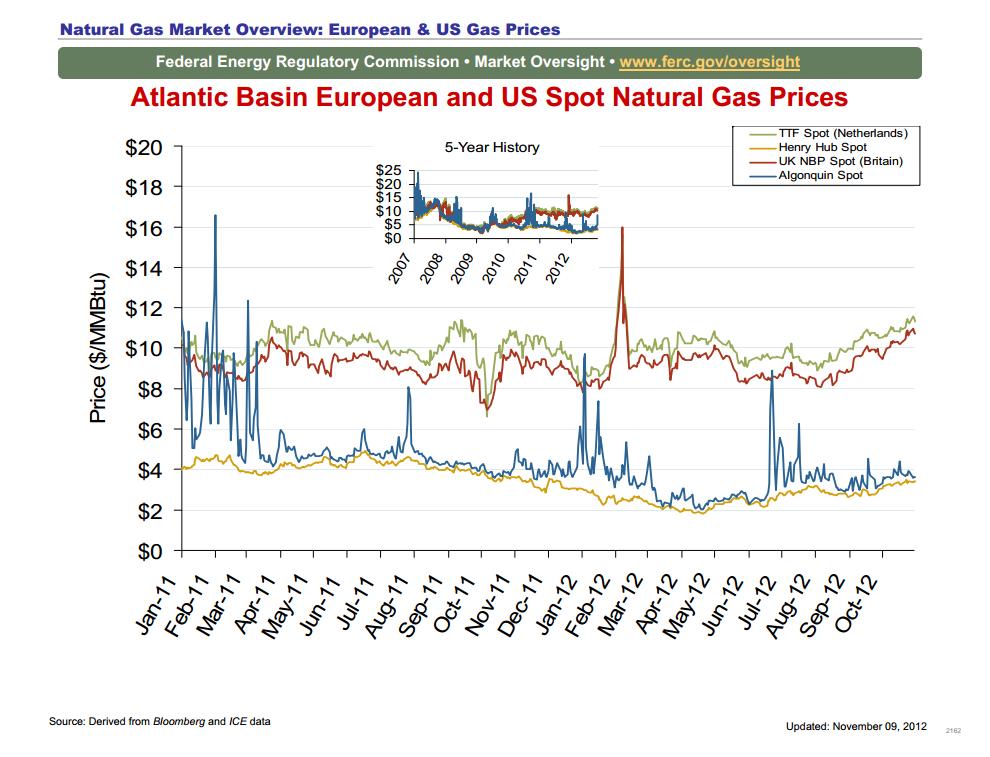
What will enhance competitiveness of the US industry will have the reverse effect in Europe which largely ignores shale gas on the ground of ecological worries. This will represent a competitive disadvantage to Europe not only in term of price but also independence, since Europe largely relies on non-EU supplies.

When enlarging the picture, the map shows that the US competitive advantage goes well beyond Europe: other countries are paying 3 to 4 times the US price.
Finally, the competition between energy sources had a direct impact on crude oil in the US. The gap between the Brent and WTI started to widen two years ago to reach a 20% price advantage today, not petty money.

Source:

Federal Reserve Bank of St Louis: Economic Research
http://research.stlouisfed.org/
Federal Energy Regulatory Commission: Natural Gas Markets
http://www.ferc.gov/market-oversight/mkt-gas/overview.asp
Wall Street Journal: Why Europe’s Banks Trail in Deleveraging Process
http://online.wsj.com/article/SB10001424052702303816504577303582094739676.html
Live Wall Street Journal: European Banks Still Hoarding Money
http://live.wsj.com/video/european-banks-still-hoarding-money/798ED78D-6CA2-442D-A41B-54FA9CB860A9.html?mod=wsj_article_tboleft#!798ED78D-6CA2-442D-A41B-54FA9CB860A9
Penn State University: The Economic Impacts of the Pennsylvania Marcellus Shale Natural Gas Play: An Update
http://www.anga.us/media/41077/penn%20state%20marcellus%20study.pdf
HIS: The Economic and Employment Contributions of hale Gas in the US
http://www.ihs.com/images/Shale_Gas_Economic_Impact_mar2012.pdf
PWC: Shale Gs – A renaissance in US manufacturing?
http://www.pwc.com/en_US/us/industrial-products/assets/pwc-shale-gas-us-manufacturing-renaissance.pdf

05 October 2011

Dexia in 2 slides and a few words


I warned about Dexia weeks ago, and during private discussions over the summer I discussed with a top official in Luxembourg about its demise and breakdown.


Leverage core equity / total assets: 75 x! (36x if using the Basle II Tier 1 capital definition): so, doomed in a recessionary environment where nearly 50% of loans are with local authorities that have difficulties to balance their budgets.
The French part of Dexia (formerly Crédit Local de France) is where most the group mess is coming from: the same ratio is much worse at 259 x!!! Even LTCM was not leveraged like this…

Dexia BIL (Luxembourg) is rather sound with a ratio of 18 x and its exposure to PIIGS (EUR 5 billion including EUR 536 million of sovereign debt) is manageable. DEXIA BIL will be bought by a bank like ING. I guess that Dexia BIL “legacy portfolio” (EUR 10 billion) will be consolidated with the other ones of the group into a bad bank.

Prima facie, the consolidated “legacy portfolio” does not look so bad: “only” EUR 7.7 billion non-investment grade; well, (1) what is investment grade today may rapidly become sub- investment grade tomorrow (see Greece) and (2) the EUR 4.1 billion allocated capital to the “legacy division” is not sufficient to match a 30% loss on the NIG loans.

In 2Q11, Dexia’s portfolio was reduced by EUR 6.8 billion vs. end of March 2011 with a loss of EUR 4 billion, i.e. ~60% mark-down.

Greece was provisioned for 21% (the IFF* agreement); the final loss will be between 50% and 75%, somore losses to come.

Short-term Funding need down EUR 47 bn which can only be funded with central banks, since I guess that Dexia is shut down from the interbank market.

This is a remake of the Irish banks: Dexia successfully passed the 2011 EBA test which was meant to be much more stringent: a joke I wrote in July.

* Institute of International Finance: the international professional organisation of banks
Conclusion

After Irish banks last year, Dexia situation exemplify the inadequacy of EBA tests which were politically motivated. For 3 years, the policy of denial followed by policy makers regarding Greece default and banks recapitalization has spurred volatility in markets: investors are reacting to hard facts and hate uncertainty and lack of action. Markets do not want words but acts.

It also shows how the poor quality of blinded European politicians made a limited disease become metastatic.

Continue to stay clear of European financial stocks (if you are a long term investor, there is better value elsewhere – if you are a trader volatility is always good): with Basle III and other rules, the finance industry will deliver lower long term returns on equity as written on this blog for 2 years.


Source:


Dexia Group: semi-annual report June 2011

http://www.dexia.com/EN/shareholder_investor/results/Documents/20110408_financial_report_2Q_UK.pdf


Dexia CLF: Rapport financier semestriel au 31 juin 2011

http://public-dexia-clf.dexwired.net/DCL/informations-juridiques-financieres/Documents/semestriel-dcl-2011.pdf


Dexia BIL : Rapport semi-annuel au 30 juin 2011

https://www.dexia-bil.lu/fr/Documents/resultats-financiers/rapport-semi-annuel-dexial-2011.pdf

04 August 2011

Open letter to the President of the Eurogroup

In a follow-up of a letter written in March 2010 about the Greek rescue and following articles in the ensuing months, I wrote a new letter to Jean-Claude Juncker, the President of the Eurogroup and Prime Minister of Luxembourg, regarding the new rescue package for Greece and published in the Luxembourger Wort; for my English reader I will prepare an article in English in the coming days.

Lettre ouverte au Premier Ministre
Un an après

Monsieur le Premier Ministre,
En mars 2010 je vous écrivais une lettre ouverte soulignant l’inefficacité et l’échec prévisible du plan de sauvetage de la Grèce. Un an après, les faits m’ont malheureusement donné raison. Le nouveau plan de sauvetage (doublement des aides publiques à EUR 219 milliards) tel que décidé le 21 juillet n’a également aucune chance de succès: ce n’est pas en ajoutant de la dette à la dette qu’on résoudra un problème de surendettement et manque de compétitivité.
1. La zone euro de plus en plus dans la tourmente
Depuis le début du mois de mai la zone euro est revenue sur le devant de la scène médiatique, suite à la publication d’un article dans le «Der Spiegel» mentionnant la sortie de la Grèce de l’euro et la tenue d’une réunion secrète au Luxembourg à ce sujet: quelque soit  la rhétorique, seule demeure et seule compte la réalité des faits ignorés depuis trop longtemps dans la construction de l’Europe et de la zone euro en particulier.
Je suis surpris de la (fausse) naïveté avec laquelle les dirigeants européens ont pu croire convaincre les investisseurs que la Grèce (et le reste des PIGS[1]) était sauvée, comme s’ils étaient incapables de conduire une analyse objective de la situation et d’en tirer des conclusions.
Dans une situation de surendettement, aucun plan d’austérité, aussi draconien soit-il, n’a jamais réussi sans s’accompagner d’une restructuration de la dette (d’un défaut donc) et d’une dévaluation de la monnaie afin de rapidement rétablir la compétitivité de l’économie. On peut continuer à ajouter plan d’austérité sur plan d’austérité et privatiser afin de gagner du temps, mais sans rien résoudre au fonds c’est l’échec garanti; et j’émets de sérieux doutes sur la capacité de la Grèce de privatiser à hauteur de EUR 50 milliards dans le temps imparti.
Je suis encore plus surpris qu’on puisse penser qu’on soignerait un malade du surendettement en lui administrant encore plus de dette: l’overdose est toujours suivie d’un décès. Ce n’est pas d’un problème de liquidité dont souffre la Grèce, mais d’un problème de solvabilité.
J’ose croire que les équipes chargées de suivre les progrès du budget grec auront remarqué la façon dont la Grèce a grossièrement manipulé les chiffres en février et mars 2011, dissimulant un déficit de EUR 1.6 milliards supérieur aux montants annoncés, et pourtant les déclarations officielles se gaussaient du succès du plan d’austérité mis en œuvre. Au cours des 6 premiers mois de l’année, le déficit est de 23% supérieur aux prévisions[2], s’établissant à EUR 12.8 milliards, la dette s’élevant à EUR 358 milliards (+ EUR 18 milliards / fin décembre 2010 et +80% / au même chiffre du 1er semestre 2010).
2. Un problème de crédibilité
Après la politique du déni, la politique du bouc-émissaire: les agences de notation et toujours les spéculateurs qui seraient responsables de l’aggravation de la crise actuelle. Les commissaires européens Reding et Barnier se plaignent de la toute puissance des agences de notation anglo-saxonnes en occultant les raisons qui ont conduit à la dégradation (bien tardive) de la note grecque et des autres pays concernés; mais après tout, ils peuvent également consulter l’agence de notation chinoise Dagong qui est bien plus sévère (réaliste) que les Fitch, S&P ou Moody’s et a abaissé la note de nombreux pays occidentaux bien avant les agences précitées.
La crédibilité d’une agence de notation européenne ne sera établie que si elle est véritablement indépendante et non aux ordres de Bruxelles ou telle autre capitale - l’exemple donné l’année dernière par les «stress tests» des banques européennes était risible et pitoyable (rappelons que les banques irlandaises les avaient passés avec succès pour être en situation de faillite quelques mois après). Le résultat des «stress tests» publié le 15 juillet est à peine moins risible: les critères de résistance devaient être beaucoup plus sévères, mais point trop n’en faut! Ainsi, le défaut d’un pays européen ne fut pas pris en compte alors que ce fut admis de facto 6 jours après à l’issue de la réunion du Conseil de l’Union Européenne… Dans le cas le plus sévère, il ne manquerait selon l’EBA[3] que EUR 2.5 milliards de fonds propres pour 8 banques. C’est une douce plaisanterie! Ainsi, l’IIF[4] annonçait le même 21 juillet que la participation « volontaire » du secteur privé (principalement les banques) au deuxième plan de sauvetage représenterait une perte de 21%…
Ces tests n’avaient comme objectif que de convaincre les investisseurs que tout allait bien pour les banques françaises et allemandes; or avec un ratio dette PIGS / fonds propres de 21% chacune pour la Société Générale et BNP Paribas, et respectivement de 14% et 27% pour Deutsche Bank et Commerzbank, elles sont sous-capitalisées (les banques italiennes sont très peu exposées aux PIGS), et le temps «gagné» (perdu?) n’a pas été suffisant. Car au-delà de la Grèce, c’est l’ensemble des pays surendettés de la zone euro qu’il convient de prendre en compte (PIGS, Italie, France et Belgique). Le FESF[5] avec ses EUR 440 milliards de fonds serait dans l’incapacité de faire face à une instabilité touchant l’Espagne ou l’Italie, encore moins la France. A court terme la possibilité qui lui a été donné d’acheter de la dette souveraine permettra de desserrer l’étau autour de la BCE dont le bilan est extrêmement dégradé avec l’achat de dette des PIGS depuis mai 2010.
L’Europe a un sérieux déficit de crédibilité et rien d’efficace n’a été entrepris depuis la crise financière pour la renforcer. Or, une des tâches essentielles de l’Europe c’est d’asseoir sa crédibilité.
3. Un an après: une analyse similaire
L’austérité budgétaire se traduira par une augmentation très importante du chômage et des rentrées fiscales détériorées, corollaire d’une croissance économique moindre que les prévisions dont je soulignais l’optimisme béat; exiger des mesures d’austérité supplémentaires, certes nécessaires, ne changera en rien l’indispensable augmentation des recettes fiscales car l’équation a deux variables et ne s’attaquer qu’aux dépenses tuera un malade d’ores et déjà moribond. La Grèce (et pas seulement elle) a un problème de recettes fiscales qui est en partie due à une fraude institutionnalisée mais surtout à un manque de compétitivité et donc de croissance. Or la croissance du PIB provient de quatre sources: la consommation des ménages et des entreprises, l’investissement, les dépenses publiques et une balance commerciale positive. Comment peut-on donc espérer résoudre le problème sans s’intéresser sérieusement à ces quatre composantes?
Ainsi, le manque de compétitivité sur les marchés mondiaux continue à se traduire par un déficit de la balance commerciale: selon l’OCDE, USD 273 milliards cumulés depuis 2000 soit ~60 % de la dette actuelle, dette largement financée par les investisseurs étrangers, alors que l’Allemagne enregistrait USD 1.501 milliards d’excédents sur la même période. Depuis le milieu des années 2000, la balance commerciale des pays d’Europe du sud (France comprise) s’est fortement dégradée. Ce déséquilibre est une des causes du mauvais fonctionnement de la zone euro: l’Europe du sud a besoin d’un taux de change EUR/USD à 1.1 alors que l’Europe du nord se satisfait de 1.5. Nous avons un bloc allemand qui a entrepris des réformes de fonds depuis la deuxième moitié des années 90 et offre des produits industriels à très forte valeur ajoutée peu élastiques au prix, alors que l’Europe du sud s’est satisfaite d’une croissance basée sur la consommation; ainsi la France a-t-elle perdu 1/3 de ses marchés à l’export. Deux réalités économiques et sociales différentes cohabitent sous une même monnaie et il n’y a que deux solutions viables pour sortir de cette quadrature du cercle:
·        Le fédéralisme harmonisant les politiques sociales et fiscales, l’Europe du nord acceptant des transferts fiscaux massifs vers l’Europe du sud, transferts s’accompagnant d’une mise sous tutelle économique et budgétaire (au minimum) des Etats du sud, ces transferts ayant comme objectif principal de rétablir la compétitivité. N’oublions pas que le surendettement va toujours de pair avec une perte de souveraineté.
·        La sortie du bloc allemand de la zone euro, avec la coexistence de deux zones euro, l’une faible centrée sur la France, l’autre forte organisée autour de l’Allemagne.
Une troisième solution consisterait pour la BCE à suivre la FED et à ouvrir encore plus largement les vannes de la création monétaire, mais je doute que l’Allemagne puisse accepter cela tant qu’elle demeurera dans la zone euro. L’inflation est le moyen le plus simple pour régler une dette mais une échappatoire désastreuse à moyen et long terme.
Le défaut de la Grèce a été acté le 21 juillet par les Chefs d’Etat de la zone euro malgré la sémantique mais la logique n’a pas été poussée jusqu’à sa conclusion finale: organiser la restructuration de la dette en faisant porter le coût en priorité au secteur privé. Espérer qu’une croissance soudainement revenue dégageant des excédents budgétaires miraculeux résoudra la crise du surendettement est ignorer la réalité des faits. A ce sujet, et pour souligner l’irréalisme de la position actuelle des dirigeants de la zone euro, il faudrait à la Grèce une croissance du PIB supérieure à 20% par an pendant 10 ans afin de revenir au critère de Maastricht de 60% dette/PIB: bien sûr, ceci est totalement impossible.
En analysant les chiffres publiés par l’EBA, on s’aperçoit que les 90 banques étudiées ont dégagé EUR 77 milliards de profit après impôt en 2010 dont EUR 28 milliards versés en dividendes, chiffres à rapprocher des EUR 68 milliards de pertes en cas de défaut de la Grèce (EUR 200 milliards de pertes pour l’ensemble des PIGS sur la base d’un coût de restructuration de 50% - à noter que l’exposition des banques à la dette souveraine italienne est de EUR 286 milliards soit un chiffre équivalent à l’Espagne). Elles ont donc la capacité d’absorber un tel choc, même si certaines devraient être recapitalisées et d’autres purement et simplement mises en faillite.
Il est largement temps de mutualiser les pertes avec ceux qui en ont la responsabilité première, et de laisser le contribuable reprendre son souffle, sachant que de toute façon il épongera les dettes étatiques. Il est temps d’agir de façon convaincante car le cyclone se rapproche de la France et de la Belgique, l’Italie étant déjà touchée.
Une des bases du capitalisme est de responsabiliser les divers intervenants et les sanctionner quand il y a lieu, et c’est une des fonctions des marchés financiers et de ceux qu’on nomme avec effroi et mépris les spéculateurs, qui sont avant tout des investisseurs. Sans eux, rien n’aurait forcé les autorités européennes et les gouvernements à agir, jusqu’à la faillite brutale, et là nous serions engagés dans une aventure dont je préfère ne pas imaginer les conséquences. J’aurais donc tendance à leur en être gré plutôt que de les vilipender.
Il est grand temps d’agir de façon courageuse, réaliste, décisive et forte, c’est d’ailleurs ce qui différencie les Hommes d’Etat des politiciens. L’alternative est l’accélération de la paupérisation des européens, appauvrissement déjà bien engagé.
Je vous remercie, Monsieur le Premier Ministre, d’avoir accordé quelques minutes de votre temps à la lecture de cette lettre.
Pascal Morin
Markets & Beyond
http://marketsandbeyond.blogspot.com/
27/07/201


[1] Portugal, Irlande, Grèce, Espagne
[2] le double en prenant en compte la manipulation des chiffres du programme d’investissements publics
[3] European Banking Authority
[4] Institute of International Finance – l’association mondiale des institutions financières
[5] Fonds Européen de Stabilité Financière

17 April 2011

Banks’ exposure to PIGS countries

© Markets & Beyond
 
Every quarter, the BIS publishes with a 6 months lag, banks exposure country by country. I drew a table to compare the evolution from June to September 2010; banks in main creditor’s countries continued to cut (sell to the ECB) their exposure in the tune of well over EUR 100 billion, and there is no reason that this trend has abated since:
However, banks in Germany, France and the UK remain deeply vulnerable with commitments of over EUR 1 trillion:
Source:
Bank for International Settlements: Consolidated foreign claims of reporting banks
http://www.bis.org/publ/qtrpdf/r_qa1103.pdf#page=72

14 September 2010

BIS and new capital rules: God bless you!

The world’s top bank regulators agreed Sunday on new rules intended to make the global banking industry safer and protect international economies from future financial disasters.
The centerpiece of the agreement is a measure that requires banks to raise the amount of common equity they hold from 2% to 4.5%. In addition, banks will be required to hold a capital conservation buffer of 2.5% to withstand future periods of stress bringing the total common equity requirements to 7%. If banks needed to dip into that 2.5% buffer, they would face restrictions on how much they could pay executives or distribute to shareholders. An additional mandatory 2.5% countercyclical buffer was however dropped and replaced by a discretionary amount in the range of 0% – 2.5% of common equity or other fully loss absorbing capital to be implemented according to national circumstances. This buffer will only be in effect when there is excess credit growth that is resulting in a system wide build up of risk.

For banks, this is good news. The new minimum ratio of core tier one capital to risk-weighted assets will be 7 per cent is quite lenient, and the implementation is phased gradually until the end of 2018. Banks would have to begin raising their common equity levels in 2013. The implementation of the countercyclical buffer will be subject of lobbying from banks to make sure it is kept to the minimum possible, i.e. 0%; a lot of politics is going to get in between; the BIS should have imposed it despite cry foul from banks (European ones in particular that are undercapitalized).
 
Return on Equity of banks will mechanically decrease having to put aside more equity for the same amount of assets, everything being equal. And it is probable however that part of this will passed onto customers, especially retail ones: credit will not come cheaper.

Source:
BIS: Press release - Group of Governors and Heads of Supervision announces higher global minimum capital standards
http://www.bis.org/press/p100912.pdf

09 September 2010

Europe’s bank stress tests: Follow-up

On September 7, the WSJ published an article which outlined why the criteria used for the 91 European banks stress tests minimized the debt risk in their portfolios. In particular it pinpointed discrepancies between data published by the BIS and the stress tests. The CEBS did respond to the article, unconvincingly however. If transparency was real one should be able to reconcile the numbers or at least explain the differences.
There is however a series of information that corroborate a widespread skepticism about these politically motivated tests triggered in July in a panicky mood which I expressed at the time of their release (Europe’s banks stress test: not really stressful…).
  1. Among the five Greek bank tested only one failed. The National Bank of Greece successfully passed the tests with a 9.6% tier 1 capital ratio in the adverse scenario and 7.4% if a sovereign shocked was to occur, well above the 6% required. This week, the very same bank announced plans to raise EUR 2.8 billion via an asset sale (EUR 1 billion) and a combination of equity and convertible bonds (EUR 1.8 billion); these EUR 2.8 billion are to compare to the EUR 3.5 billion that the 7 banks that failed the tests had to raise… European politicians and regulators are lacking credibility indeed.
  2. Portuguese banks increased their borrowing (+0.6% August/July) from the ECB to reach EUR 49.1 billion. This is another sign of the failing health of Europe’s banking system. Irish, Spanish and Greek banks are also reliant on the ECB for funding.
  3. In July, the European Central Bank loaned 132 billion euros for three months to 171 financial institutions. ECB President Jean-Claude Trichet on Sept. 2 extended emergency lending measures for banks into 2011. The ECB has bought €61bn in government bonds – mostly of the weaker eurozone economies of Greece, Ireland and Portugal – since it launched its intervention program on May 10 as part of the multibillion-euro international bailout.
All this has resulted in a surge in the risk premium the market is asking to hold PIIGS debt which are moving towards their record highs.

And with Basel III more stringent capital ratios to be discussed at the November 11-12 G20 meeting in Seoul, I continue to stay clear from European banks.

Source:

The Wall Street Journal: Europe's Bank Stress Tests Minimized Debt Risk
http://online.wsj.com/article/SB10001424052748704392104575475520949440394.html?mod=WSJEUROPE_hps_LEFTTopWhatNews

Markets & Beyond: Europe’s banks stress test: not really stressful…
http://marketsandbeyond.blogspot.com/2010/08/europes-banks-stress-test-not-really.html

The Financial Times: ECB steps up eurozone bond buying
http://www.ft.com/cms/s/0/a70e9b82-bb76-11df-a136-00144feab49a.html

The Financial Times: Portugal suffers as lending costs soar
http://www.ft.com/cms/s/0/0e3b7f1a-baa9-11df-b73d-00144feab49a.html

Bloomberg: Europe's Banks Stressed By Sovereign Debts Regulators Ducked
http://www.bloomberg.com/news/2010-09-06/europe-s-banks-stressed-by-sovereign-debts-eu-regulators-failed-to-examine.html

Committee of European Banking Supervisors: 2010 EU Wide Stress Testing
http://www.c-ebs.org/EuWideStressTesting.aspx

22 August 2010

Greece: no news, good news? Not really...

After the Q2 2010 turmoil in debt markets across the euro-zone following Greek debt problem, everything went quiet from mid-July onwards: the euro dramatically jumped, CDS spreads shrunk and sovereign debt yields followed and media went quiet, like a remake of the Phoney war on the western front at the beginning of WWII.
We had however a few announcements and markets anticipations/reactions:
  • Slovakia did not participate in the first tranche of help to Greece and August 12 the parliament voted overwhelmingly (69-2) to reject taking part in a European Union aid package to Greece – wise men! The angry reaction from the European Commission tells a lot about its disrespect of democracy (this is one of the main roots of the flawed EU construction as we have witnessed it for the past 20-25 years – and don’t talk to me about the European parliament which is nothing more than a puppy House of Representatives). Whilst Slovakia participation in the rescue package (just over 1% of the European participation – EUR 80 billion) is meaningless, its parliament vote is meaningful: countries how small they are ready to stand and say enough is enough; democracy can regain control.
  • Without any surprise (who can think it would have been otherwise?!), on August 19 the European Commission said that Greece meets the conditions to receive the second part of the EUR 110 billion three-year emergency-loan package agreed on May 2: EUR 9 billion (including EUR 2.5 billion from the IMF); so we are at EUR 29 billion and counting (remember it was agreed that Euro-zone would lend EUR 30 billion during year 1 – we already are at 2/3)... This second tranche will be agreed by European Finance Ministers on September 7.
  • On the economic front, Greece’s GDP shrunk for the 7th quarter in a row at -1.5% during Q2 and inflation jumped to an annualized rate of 5.2%; I guess this inflation increase, way away from the rest of the euro-zone, is due to tax increases passed onto consumers. We are better Greece posting a nominal GDP growth in 2010 if such inflation continues on the same path, or one will have to very worried.
Let’s have a look at the 6 month progress report.
The numbers look rather encouraging with a 47.9% reduction in the ordinary budget for H1 yoy.
The revenue side remains however weak at +5.8% during the January-June period (42% of 2010 budgeted revenues), but we will have a clearer view of tax receipts in the next quarterly progress report, and in particular VAT and consumption taxes that represent over 2/3 of Greece’s revenues.
Most of the current reduction in the deficit comes from a decrease in expenditures (+/- 80% of the improvement). However, H1 expenditures already represent 55% of the full year budget.. A closer look at expenditures makes me more than circumspect regarding Greece chance to succeed. 60% of PIB have to be spent during H2 according to the most recently revised budget (and the EUR 9.2 billion has been reviewed downward in the tune of EUR 500 million compared to May) and interest rate payment will increase during H2 since the euro-zone loan bears a 5% rate and Greece has borrowed short term at rate much higher than last year, whilst it shows a decrease compared to 2009. You can see the squeeze: ahead for expenditures and late for revenues (Greece has a wild card: the EUR 3 billion EU help for infrastructure not yet paid that could arrive at the right time...).
Greece can squeeze even more expenditures but the key is on the revenue side and the bottom line is GDP growth. Without any growth, Greece will not be in a position to mend its public finances, and recent economic indicators are not encouraging; in addition, with inflation more than double the Euro-zone average and the GDP still shrinking, the economic divergence with the rest of Europe is increasing not the reverse. And do not forget, Greece is taking more debt every month, mostly financed by other Euro-zone countries and the IMF and its debt-to-GDP ratio follows the same path.
Greece is in a debt trap and I continue to believe that a debt rescheduling (not to call it a default), is the only solution to avoid a straight default or a breakup of the euro-zone. The German economy is doing well thanks to its exports. The economic (and social? political?) rift between Northern Europe and Southern Europe (France included) is widening. This is not sustainable.
What are markets telling us? 
After a relief (and an over-short market) following the publication of stress test for banks across Europe, the euro, sovereign debt yield and CDS spreads are again moving in the direction of anxiety.
Yield on Greek debt are again on the move…
… whilst at the same time yields on the German debt are reaching historic lows, therefore the spread between Greece and Germany is reaching historic highs and …
... the Euro is backing down after a 10% rally.
Finally, I had a look at the BIS quarterly bulletin and I noticed that French banks reduced their exposure to the Greek debt at the end of March, down to EUR 67 billion (-EUR 8 billion) whilst and German banks remained flat at EUR 44 billion compared to the end of 2009. I guess that this exposure has been further reduced since, the ECB becoming the investor of last resort.
In the meantime, the BIS is watering down new regulations to strengthen capital ratios for banks, putting emphasis on core capital; this will drag on, otherwise, the stress test that European banks passed so “successfully” would look meaningless (what it is anyway).
What about investments?
I have not changed for a couple of months: stay clear of Western banks (they are not all that bad, but there is better value elsewhere), invest in high growth economies (directly or via proxy companies), brand name consumer goods, and generally speaking companies with a franchise, a strong balance sheet and high yield on their shares (in this environment, income is key).
Source:
Financial Times: Slovakia under fire over Greece
http://www.ft.com/cms/s/0/2de394aa-a641-11df-8767-00144feabdc0.html
Financial Times: Greece to receive further €9bn of bail-out
http://www.ft.com/cms/s/0/d71db766-ab88-11df-abee-00144feabdc0.html?ftcamp=rss
Hellenic Ministry of Finance: Budget execution – June 2010
http://www.minfin.gr/content-api/f/binaryChannel/minfin/datastore/0a/12/d0/0a12d0a39f9113e806532a1c85e7146470fe5a7a/application/pdf/100720_Bulletin_6_ENG_20-7-2010.pdf
Hellenic Ministry of Finance: The economic adjustment programme for Greece
http://ec.europa.eu/economy_finance/sgp/pdf/30_edps/other_documents/2010-08-06_el_progress_report_en.pdf
Bank for International Settlements: Detailed tables on provisional locational and consolidated banking statistics at end-March 2010
http://www.bis.org/statistics/provbstats.pdf#page=66

02 August 2010

Europe’s banks stress test: not really stressful…

Whilst the ECB was first and foremost to react to the hedge fund collapse of Bear Stearns and BNP Paribas during August 2007, Europe has been running behind events ever since. Within the EU, the recent June decision to screen the main EU banks risk/capital adequacy and publish the findings was taken on the back of a unilateral decision by Spain following the seizure of its banking sector in June.
Being behind events does not mean that the exercise is not useful if properly conducted, whilst its main aim was for policymakers to calm down the markets. I am not going to review at length the criteria used, since the claimed transparency is somewhat tainted with opacity.
Scope of the test
The stress test was conducted on 91 European banks in 27 countries representing 65% of the total assets of the EU banking sector or EUR 28 trillion, which is representative enough.
It covers 2010 and 2011 and mainly focuses on credit and market risks.
Banks pass the test if their Tier one capital over their risk weighted assets reaches a 6% threshold (the regulatory minimum Tier one capital in Europe is 4%).
Adverse macro-economic scenario
The assumptions concerning GDP growth are no so adverse: a 2% drop in GDP over 18 months doe not cry foul, particularly if countries outside Europe see their growth decrease significantly (a real possibility in the US a possibility in Asia). However, I can live with this. As I do with the assumption concerning a 175 basis points hike for 3 months rates and 75 basis points for 10 years by the end of 2011, even if in case of crisis these would most likely head north and fast.
Sovereign debt
The haircut applied to sovereign debt is not appropriate: it is not a question of taking off, 10% here, 2% there and 4% elsewhere. It is a binary game: a country defaults or not; in case of default the haircut will be much larger than the ones assumed in the CEBS analysis. Again, I can live with this.
Where things are becoming questionable is the treatment of sovereign debt in banks books. A cut is applied to the trading book whilst none is for the “investment” book; I must admit that the difference is quite specious: either a country can default or not and any investment would be affected. European policy makers said that there no way that any European country will be allowed to default; well, they also said that the euro would enhance economic growth and protect European citizens (the famous fortress Europe - like the Maginot line of defense)... In addition, if only 7 banks have to quickly raise EUR 3.5 billion of equity, 17 banks have a ratio comprised between 6 and 7% (including Deutsche Bank, the largest German bank which may explain why Germany refused to publicize details of the sovereign debt books of German Banks).
As stated by the CEBS report:
In total, aggregate impairment and trading losses under the adverse scenario and additional sovereign shock would amount to 566bn € over the years 2010-2011.
The aggregate Tier 1 ratio, used as a common measure of banks’ resilience to shocks, under the adverse scenario would decrease from 10.3% in 2009 to 9.2% by the end of 2011 (compared to the regulatory minimum of 4% and to the threshold of 6% set up for this exercise). The aggregate results depend partly on the continued reliance on government support for currently 38 institutions in the exercise.
The aggregate Tier 1 ratio incorporates approximately 197bn € of government capital support provided until 1 July 2010, which represents 1.2 percentage point of the aggregate Tier 1 ratio.
So the picture looks rather rosy with plenty of cushion…
However, beyond affirming that no European country will allowed to default (saying otherwise would trigger a new rout on banks and the euro) does not mean that it could not occur (please note that I do not believe that a EU country – at least any eurozone country – will default straightforwardly, but I do believe that a rescheduling of debt is on the cards GDP growth failing to deliver enough to service it which according to my simulations is at least true for Greece). To conclude, trading books were tested and cleared from a double-dip recession – not the complete balance sheet impact of a sovereign debt default was analyzed.
There are at least two additional questions: 
  • Did the study take into account rating downgrades that would require banks to match their assets with more capital?
  • There is no test taking into account core capital only; banks have used financial engineering to boost their Tier one capital ratios instead of core equity to enhance their return on equity. In my opinion core equity is the real parameter to take into account to test bank’s stress conditions.
After a mild reaction on Monday 26th July, banks shares showed strong gains, particularly in the eurozone and this continues today (August 2nd). This has however probably more to do with the Basel Committee on Banking Supervision that moderated several of its planned rules that would have required more capital and increased costs for banks on the very same Monday. In the meantime, CDS 5 yr spreads across Europe went down between 20 et 50% since June peak. Accounting rules also remain accommodating.
To conclude, the stress tests fulfilled their objective short term to calm markets; longer term, the fundamentals of Greece and several other European countries with structural budget deficits and subdued growth are not properly addressed. This will come back to the forefront of market concerns in the coming 12 months. Meanwhile, I will closely follow the progress of the Greek stabilization plan and GDP growth.
Source:
Committee of European Banking Supervisors (CEBS): Aggregate outcome of the 2010 EU wide stress test exercise coordinated by CEBS in cooperation with the ECB
http://stress-test.c-ebs.org/documents/Summaryreport.pdf
FT: Triple bonus boosts Europe bank shares
http://www.ft.com/cms/s/0/7f0e9e16-99a7-11df-a852-00144feab49a.html?ftcamp=rss

11 July 2010

Europe: The State of the Banking System

I publish in extenso an interesting analysis from STRATFOR concerning the European banking and sovereign crisis. I am in agreement with everything written.
Stratfor is a deep, far and well-thought strategic intelligence and analysis service on topics ranging from geopolitics to economics. You can sign up for their free email list to receive weekly reports and special offers: http://www.stratfor.com/
Summary
In the last six months, the eurozone has faced its biggest economic challenge to date — one sparked by the Greek debt crisis which has migrated to the rest of the monetary union. But well before the sovereign debt crisis, Europe was facing a full-blown banking crisis that did not seem any closer to being resolved than when it began in late 2008. With investors and markets focused on European governments' debt problems, the banking issues have largely been ignored. However, the sovereign debt crisis and banking crisis have become intertwined and could feed off each other in the near future.
Analysis
July 1 is a milestone for eurozone banks, with 442 billion euros ($541 billion) worth of European Central Bank (ECB) loans coming due. The loans were part of the ECB's one-year liquidity offering made in 2009, which was intended to help stabilize the banking system.
However, one year after the ECB provision was initially offered, the eurozone's banks are still struggling, and now Europe's banks must collectively come up with the cash roughly equivalent to Poland's gross domestic product (GDP).
Fears regarding the potentially adverse consequences of removing ECB liquidity are gripping many European banks and, by extension, investors who were already panicked by the sovereign debt crisis in the Club Med countries (Greece, Portugal, Spain and Italy). These concerns are as much a testament to the severity of the eurozone's ongoing banking crisis as to the lack of resolve that has characterized Europe's handling of the underlying problems.
Origins of Europe's Banking Problems
Europe's banking problems precede the eurozone's ongoing sovereign debt crisis and even exposure to the U.S. subprime mortgage imbroglio. The European banking crisis has its origins in two fundamental factors: euro adoption in 1999 and the general global credit expansion that began in the early 2000s. The combination of the two created an environment that inflated credit bubbles across the Continent, which were then grafted onto the European banking sector's structural problems.
In terms of specific pre-2008 problems we can point to five major factors. Not all the factors affected European economies uniformly, but all contributed to the overall weakness of the Continent's banking sector.
1. Euro Adoption and Europe's Local Subprime Bubble
The adoption of the euro — in fact, the very process of preparing to adopt the euro that began in the early 1990s with the signing of the Maastricht Treaty — effectively created a credit bubble in the eurozone. As the adjacent graph indicates, the cost of borrowing in peripheral European countries (Spain, Portugal, Italy and Greece in particular) was greatly reduced due, in part, to the implied guarantee that once they joined the eurozone their debt would be as solid as Germany's government debt.
In essence, euro adoption allowed countries like Spain access to credit at lower rates than their economies could ever justify based on their own fundamentals. This eventually created a number of housing bubbles across Europe, but particularly in Spain and Ireland (the two eurozone economies currently boasting the relatively highest levels of private-sector indebtedness). As an example, in 2006 there were more than 700,000 new homes built in Spain — more than the total new homes built in Germany, France and the United Kingdom combined, even though the United Kingdom was experiencing a housing bubble of its own at the time.
It could be argued that the Spanish case was particularly egregious because Madrid attempted to use access to cheap housing as a way to integrate its large pool of first-generation Latin American migrant workers into Spanish society. However, the very fact that Spain felt confident enough to attempt such wide-scale social engineering indicates just how far peripheral European countries felt they could stretch their use of cheap euro loans. Spain is today feeling the pain of a collapsed construction sector, with unemployment approaching 20 percent and with the Spanish cajas (regional savings banks) reeling from their holdings of 58.9 percent of the country's mortgage market. The real estate and construction sectors' outstanding debt is equal to roughly 45 percent of the country's GDP.
2. Europe's 'Carry Trade'
"Carry trade" usually refers to the practice in which loans are taken in a low interest rate country with a stable currency and "carried" for investment in the government debt of a high interest rate economy. The European practice, which extended the concept to consumer and mortgage loans, was championed by the Austrian banks that had experience with the method due to their proximity to the traditionally low interest rate economy of Switzerland.
In the carry trade, the loans extended to consumers and businesses are linked to the currency of the country where the low interest loan originates. Because of this, Swiss francs and euros served as the basis for most of such lending across Europe. Loans in these currencies were then extended as low interest rate mortgages and other consumer and corporate loans in higher interest rate economies in Central and Eastern Europe. Since loans were denominated in foreign currency, when their local currency depreciated against the Swiss franc or euro, the real financial burden of the loan increased.
This created conditions for a potential economic maelstrom at the onset of the financial crisis in 2008 when consumers in Central and Eastern Europe saw their monthly mortgage payments grow as investors pulled out from emerging markets in order to "flee to safety," leading these countries' domestic currencies to fall. The problem was particularly dire for Central and Eastern European countries with a great amount of exposure to such foreign currency lending (see adjacent table).
3. Crisis in Central/Eastern Europe
The carry trade led Europe's banks to be overexposed to Central and Eastern European economies. As the European Union enlarged into the former Communist sphere in Central Europe, and as security and political uncertainties in the Balkans subsided in the early 2000s, European banks sought new markets where they could make use of their expanded access to credit provided by euro adoption. Banking institutions in mid-level financial powers such as Sweden, Austria, Italy and even Greece sought to capitalize on the carry trade by going into markets that their larger French, German, British and Swiss rivals largely shunned.
This, however, created problems for the banking systems that became overexposed to Central and Eastern Europe. The International Monetary Fund and the European Union ended up having to bail out several countries in the region, including Romania, Hungary, Latvia and Serbia. And before the eurozone ever contemplated a Greek or eurozone bailout, it was discussing a potential 150 billion-euro rescue fund for Central and Eastern Europe at the urging of the Austrian and Italian governments.
4. Exposure to 'Toxic Assets'
The exposure to various credit bubbles ultimately left Europe vulnerable to the financial crisis, which peaked with the collapse of Lehman Brothers in September 2008. But the outright exposure to various financial derivatives, including the U.S. subprime market, was by itself considerable.
While the Swedish, Italian, Austrian and Greek banking systems expanded into the new markets in Central and Eastern Europe, the established financial centers of France, Germany, Switzerland, the Netherlands and the United Kingdom dabbled in various derivatives markets. This was particularly the case for the German banking system, where the Landesbanken — banks with strong ties to regional governments — faced chronically low profit margins caused by a fragmented banking system of more than 2,000 banks and a tepid domestic retail banking market. The Landesbanken on their own face between 350 billion and 500 billion euros worth of toxic assets — a considerable figure for the 2.5 trillion-euro German economy — and could be responsible for nearly half of all outstanding toxic assets in Europe.
5. Demographic Decline
Another problem for Europe is that its long-term outlook for consumption, particularly in the housing sector, is dampened by the underlying demographic factors. Europe's birth rate is at 1.53, well below the population "replacement rate" of 2.1. Exacerbating the demographic imbalance is the increasing life expectancy across the region, which results in an older population. The average European age is already 40.9, and is expected to hit 44.5 by 2030.
An older population does not purchase starter homes or appliances to outfit those homes. And if older citizens do make such purchases, they are less likely to depend as much on bank lending as first-time homebuyers. That means not just less demand, but that any demand will depend less upon banks, which means less profitability for financial institutions. Generally speaking, an older population will also increase the burden on taxpayers in Europe to support social welfare systems, dampening consumption further.
In this environment, housing prices will continue to decline (barring another credit bubble, which would of course exacerbate problems). This will further restrict lending activities because banks will be wary of granting loans for assets that they know will become less valuable over time. At the very least, banks will demand much higher interest rates for these loans, but that too will further dampen the demand.
The Geopolitics of Europe's Banking System
Given these challenges, the European banking system was less than rock-solid even before the onset of the global recession in 2008. However, Europe's response as a Continent to the crisis so far has been muted, with essentially every country looking to fend for itself. Therefore, at the heart of Europe's banking problems lie geopolitics and "capital nationalism."
Europe's geography encourages both political stratification and unity in trade and communications. The numerous peninsulas, mountain chains and large islands all allow political entities to persist against stronger rivals and continental unification efforts, giving Europe the highest global ratio of independent nations to area. Meanwhile, the navigable rivers, inland seas (Black, Mediterranean and Baltic), Atlantic Ocean and the North European Plain facilitate the exchange of ideas, trade and technologies among the disparate political actors.
This has, over time, incubated a continent full of sovereign nations that intimately interact with one another but are impossible to unite politically. Furthermore, in terms of capital flows, European geography has engendered a stratification of capital centers. Each capital center essentially dominates a particular river valley where it can use its access to a key transportation route to accumulate capital. These capital centers are then mobilized by the proximate political powers for the purposes of supporting national geopolitical imperatives, so Viennese bankers fund the Austro-Hungarian Empire, for example, while Rhineland bankers fund the German Empire. With no political unity, the stratification of capital centers becomes more solidified over time.
The European Union's common market rules stipulate the free movement of capital across the borders of its 27 member states. Theoretically, with barriers to capital movement removed, the disparate nature of Europe's capital centers should wane; French banks should be active in Germany, and German banks should be active in Spain. However, control of financial institutions is one of the most jealously guarded privileges of national sovereignty in Europe.
One reason for this "capital nationalism" is that Europe's corporations and businesses are far less dependent on the stock and bond market for funding than their U.S. counterparts, relying primarily on banks. This comes from close links between Europe's state champions in industry and finance (for example, the close historical links between German industrial heavyweights and Deutsche Bank). Such links, largely frowned upon in the United States for most of its history, were seen as necessary by Europe's nation-states in the late 19th and early 20th centuries because of the need to compete with industries in neighboring states. European states in fact encouraged — in some ways even mandated — banks and corporations to work together for political and social purposes of competing with other European states and providing employment. This also goes for Europe's medium-sized businesses — Germany's mid-sized businesses are a prime example — which often rely on regional banks they have political and personal relationships with.
Regional banks are an issue unto themselves. Many European economies have a special banking sector dedicated to regional banks owned or backed by regional governments, such as the German Landesbanken or the Spanish cajas which in many ways are used as captive firms to serve the needs of both the local governments (at best) and local politicians (at worst). Many Landesbanken actually have regional politicians sitting on their boards while the Spanish cajas have a mandate to reinvest around half of their annual profits in local social projects, tempting local politicians to control how and when funds are used.
Europe's banking architecture was therefore wholly unprepared to deal with the severe financial crisis that hit in September 2008. With each banking system tightly integrated into the political economy of each EU member state, an EU-wide "solution" to Europe's banking problems — let alone the structural issues, of which the banking problems are merely symptomatic — has largely evaded the Continent. While the European Union has made progress in enhancing EU-wide regulatory mechanisms by drawing up legislation to set up micro- and macro-prudential institutions (with the latest proposal still in the implementation stages), the fact remains that outside of the ECB's response of providing unlimited liquidity to the eurozone system, there has been no meaningful attempt to deal with the underlying structural issues on the political level.
EU member states have, therefore, had to deal with banking problems largely on a case-by-case (and often ad hoc) basis, as each government has taken extra care to specifically tailor its financial assistance packages to support the most and upset the fewest constituents. In contrast, the United States — which took an immediate hit in late 2008 — bought up massive amounts of the toxic assets from the banks, swiftly transferring the burden onto the state.
ECB to the 'Rescue'
Europe's banking system obviously has problems, but exacerbating the problems is the fact that Europe's banks know that they and their peers are in trouble. This is causing the interbank market to seize up and thus forcing Europe's banks to rely on the ECB for funding.
The interbank market refers to the wholesale money market that only the largest financial institutions are able to participate in. In this market, the participating banks are able to borrow from one another for short periods of time to ensure that they have enough cash to maintain normal operations. Normally, the interbank market essentially regulates itself. Banks with surplus liquidity want to put their idle cash to work, and banks with a liquidity deficit need to borrow in order to meet the reserve requirements at the end of the day, for example. Without an interbank market there is no banking "system" because each individual bank would be required to supply all of its own capital all the time.
In the current environment in Europe, many banks are simply unwilling to lend money to each other, as they do not trust their peers' creditworthiness, even at very high interest rates. When this happened in the United States in 2008, the Federal Reserve and Federal Deposit Insurance Corporation stepped in and bolstered the interbank market directly and indirectly by both providing loans to interested banks and guaranteeing the safety of the loans banks were willing to grant each other. Within a few months, the U.S. crisis mitigation efforts allowed confidence to return and this liquidity support was able to be withdrawn.
The ECB originally did something similar, providing an unlimited volume of loans to any bank that could offer qualifying collateral, while national governments offered their own guarantees on newly issued debt. But unlike in the United States, confidence never fully returned to the banking sector due to the reasons listed above, and these provisions were never canceled. In fact, this program was expanded to serve a second purpose: stabilizing European governments.
With economic growth in 2009 weak, many EU governments found it difficult to maintain government spending programs in the face of dropping tax receipts. They resorted to deficit spending, and the ECB (indirectly) provided the means to fund that spending. Banks could purchase government bonds, deposit them with the ECB as collateral and walk away with a fresh liquidity loan (which they could use, if they so chose, to buy yet more government debt).
The ECB's liquidity provisions were ostensibly a temporary measure that would eventually be withdrawn as soon as it was no longer necessary. So on July 1, 2009, the ECB offered the first of what was intended to be its three "final" batches of 12-month loans as part of a return to a more normal policy. On that day 1,121 banks took out a record total of 442 billion euros in liquidity loans (followed by another 75 billion euros taken out in September and 96 billion euros in December). The 442 billion euro operation has come due July 1. The day before, banks tapped the ECB's shorter-term liquidity facilities to gain access to 294.8 billion euros to help them bridge the gap.
Europe now faces three problems. First, global growth has not picked up sufficiently in the last year, so European banks have not had a chance to grow out of their problems. This would have been difficult to accomplish on such a short timeframe. Second, the lack of a unified European banking regulator — although the European Union is trying to set one up — means that there has not yet been any pan-European effort to fix the banking problems. And even the regulation that is being discussed at the EU-level is more about being able to foresee a future crisis than resolving the current one. So banks still need the emergency liquidity provisions now as they did a year ago (to some degree the ECB saw this coming and has issued additional "final" batches of long-term liquidity loans). In fact, banks remain so unwilling to lend to one another that they have deposited nearly the equivalent amount of credit obtained from ECB's liquidity facilities back into its deposit facility instead of lending it out to consumers or other banks.
Third, there is now a new crisis brewing that not only is likely to dwarf the banking crisis, but could make solving the banking crisis impossible. The ECB's decision to facilitate the purchase of state bonds has greatly delayed European governments' efforts to tame their budget deficits. There is now nearly 3 trillion euros of outstanding state debt just in the Club Med economies — vast portions of which are held by European banks — illustrating that the two issues have become as mammoth as they are inseparable.
There is no easy way out of this imbroglio. Reducing government debts and budget deficits means less government spending, which means less growth because public spending accounts for a relatively large portion of overall output in most European countries. Simply put, the belt-tightening that Germany and the markets are forcing upon European governments likely will lead to lower growth in the short term (although in the long term, if austerity measures prove credible, it should reassure investors of the credibility of the eurozone's economies). And economic growth — and the business it generates for banks — is one of the few proven methods of emerging from a banking crisis. One cannot solve one problem without first solving the other, and each problem prevents the other from being approached, much less solved.
There is, however, a silver lining. Investor uncertainty about the European Union's ability to solve its debt and banking problems is making the euro ever weaker, which ironically will support European exporters in the coming quarters. This not only helps maintain employment (and with it social stability), but it also boosts government tax receipts and banking activity — precisely the sort of activity necessary to begin addressing the banking and debt crises. But while this might allow Europe to avoid a return to economic recession in 2010, it alone will not resolve the European banking system's underlying problems.
For Europe's banks, this means that not only will they have to write down remaining toxic assets (the old problem), but they now also have to account for dampened growth prospects as a result of budget cuts and lower asset values on their balance sheets due to sovereign bonds losing value.
Ironically, with public consumption down as a result of budget cuts, the only way to boost growth would be for private consumption to increase, which is going to be difficult with banks wary of lending.
The Way Forward?
So long as the ECB continues to provide funding to the banks — and STRATFOR does not foresee any meaningful change in the ECB's posture in the near term or even long term — Europe's banks should be able to avoid a liquidity crisis. However, there is a difference between being well-capitalized but sitting on the cash due to uncertainty and being well-capitalized and willing to lend. Europe's banks are clearly in the former state, with lending to both consumers and corporations still tepid.
In light of Europe's ongoing sovereign debt crisis and the attempts to alleviate that crisis by cutting down deficits and debt levels, European countries are going to need growth, pure and simple, to get out of the crisis. Without meaningful economic growth, European governments will find it increasingly difficult — if not impossible — to service or reduce their ever-larger debt burdens. But for growth to be engendered, the Europeans are going to need their banks, currently spooked into sitting on liquidity, to perform the vital function that banks normally do: finance the wider economy.
As long as Europe faces both austerity measures and reticent banks, it will have little chance of producing the GDP growth needed to reduce its budget deficits. If its export-driven growth becomes threatened by decreasing demand in China or the United States, it could also face a very real possibility of another recession which, combined with austerity measures, could precipitate considerable political, social and economic fallout.

Source:
Strafor
http://www.stratfor.com/