Showing posts with label US banks. Show all posts

20 November 2012

Why the US economy will substantially outperform the EU for the long run


I do not intend to be comprehensive with tons of indicators which are available: I will only focus on a few which, in my opinion, are making THE difference.
1. The banking sector
Whilst US banks have largely cleaned up their balance sheet, or more exactly dramatically reduce their leverage to around 15 x, and have been able to return to markets to fund themselves at market price (the FED has withdrawn its unconventional liquidity measures), the European banking system remains under life support from the ECB in the turn of EUR1 trillion Long-Term Refinancing Operations. The European banking system has a funding gap of EUR 1.3 billion, and as the WSJ writes “… if European banks were funded the same way as U.S. banks, they would have a deposit surplus of $3 trillion”.
This is why the US banks are lending t the US economy and European banks do not finance the EU economy whilst remaining too leveraged at 30 x. To worsen the situation, banks are increasingly hoarding money with the ECB: USD1.4 trillion as of 9 November.
2. Lending to the economy

The US commercial and industrial loans from all commercial banks is an indicator I follow on a regular basis and it proved to be a good early indicator of the US economy turnaround. Velocity is however part of the money creation and has dramatically fallen since the beginning of the financial crisis.
Today, I am adding velocity to present a more precise picture. Interesting enough velocity of MZM(1) * commercial & industrial loans by all commercial banks turned up +/- 1 year ago, adding a bullishness view on the US economy, despite the fact that MZM velocity is at 1.4 x, the lowest since 1959 (when it started to be reported). Banks are financing the US economy.


(1) MZM = M2 less small-denomination time deposits plus institutional money funds. Money Zero Maturity

3. Energy
One point largely occulted by commentators regarding the US fiscal and trade deficits is the energy sector. If the US, and everything seem pointing in this direction, becomes self sufficient within 10 years, this will be huge boost to the trade balance and therefore the GDP growth.
The oil & gas 2011 trade deficit stood at $993 bn for a GDP 15,321 bn or a negative growth of 6.5%; if one assumes that thanks to unconventional oil & gas the US can reduce its energy trade deficit by 50% this would add 3% to GDP: this is a game changer and the fiscal cliff would be much easier to climb.
The unconventional gas industry will have far reaching effects including job creation and re-industrialization. According to HIS, “the shale gas production supported 600,000 jobs in 2010, a number that is projected to grow to nearly 870,000 by 2015”.

PWC mentions in a 2011 report that by 2025 shale gas will save US manufacturers USD11.6 billion a year in gas expenses and add 1 million workers.
Hence my positive stance on the US economy.
What will enhance competitiveness of the US industry will have the reverse effect in Europe which largely ignores shale gas on the ground of ecological worries. This will represent a competitive disadvantage to Europe not only in term of price but also independence, since Europe largely relies on non-EU supplies.
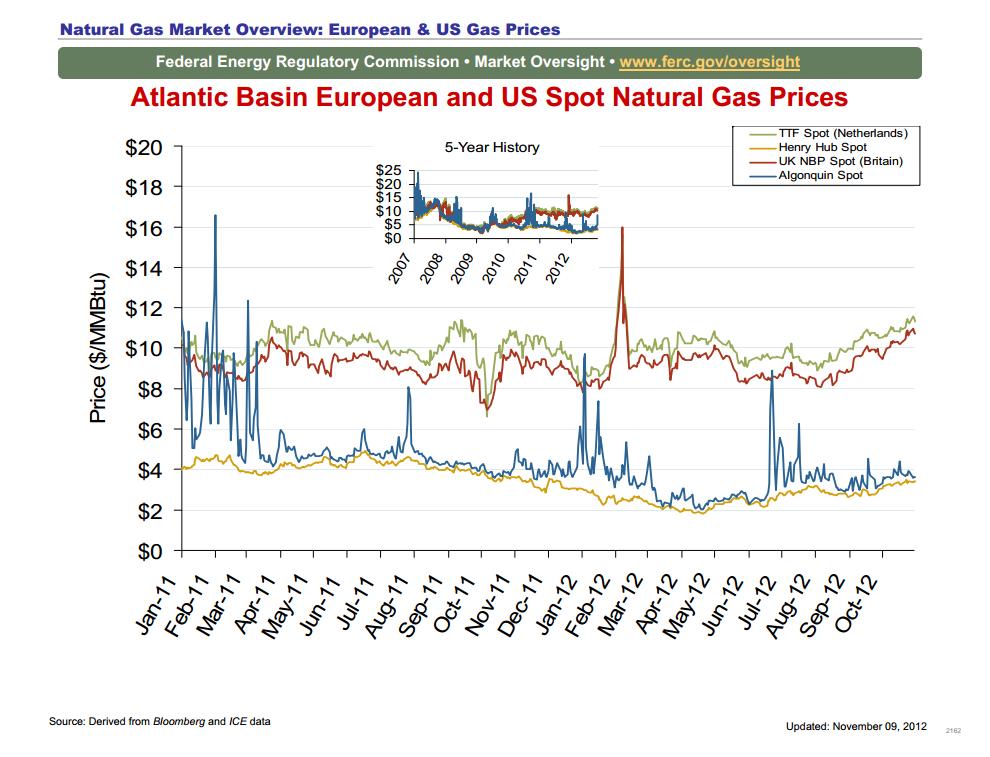
When enlarging the picture, the map shows that the US competitive advantage goes well beyond Europe: other countries are paying 3 to 4 times the US price.
Finally, the competition between energy sources had a direct impact on crude oil in the US. The gap between the Brent and WTI started to widen two years ago to reach a 20% price advantage today, not petty money.

Source:

Federal Reserve Bank of St Louis: Economic Research
http://research.stlouisfed.org/
Federal Energy Regulatory Commission: Natural Gas Markets
http://www.ferc.gov/market-oversight/mkt-gas/overview.asp
Wall Street Journal: Why Europe’s Banks Trail in Deleveraging Process
http://online.wsj.com/article/SB10001424052702303816504577303582094739676.html
Live Wall Street Journal: European Banks Still Hoarding Money
http://live.wsj.com/video/european-banks-still-hoarding-money/798ED78D-6CA2-442D-A41B-54FA9CB860A9.html?mod=wsj_article_tboleft#!798ED78D-6CA2-442D-A41B-54FA9CB860A9
Penn State University: The Economic Impacts of the Pennsylvania Marcellus Shale Natural Gas Play: An Update
http://www.anga.us/media/41077/penn%20state%20marcellus%20study.pdf
HIS: The Economic and Employment Contributions of hale Gas in the US
http://www.ihs.com/images/Shale_Gas_Economic_Impact_mar2012.pdf
PWC: Shale Gs – A renaissance in US manufacturing?
http://www.pwc.com/en_US/us/industrial-products/assets/pwc-shale-gas-us-manufacturing-renaissance.pdf

19 February 2010

FED quantitative easing exit: has it started?

The FED 0.25% discount rate hike yesterday evening came as a surprise. Banks are now borrowing at 0.75% instead of 0.5%, not a big deal: there is still plenty of space for banks to play the yield curve.

Two days ago I wrote that I did not see a hike in interest rates any time soon, so this move is a surprise regarding the timing. First, its significance is rather minor since it is applied to emergency funds provided by the FED to financial institutions. The fed funds (0.25%) are the ones that really matter since they impact borrowing costs for companies and consumers (mortgage in particular) and the FED indicated that an increase in the discount rate did not imply an increase in FED fund in the future. Second, I view this increase as is a signal sent to the market psyche about the FED seriousness in preparing the QE exit, controlling future inflation and therefore tame investors' future inflation expectation to keep rate in check (don't forget that the US a has a huge debt to finance).
True, the Fed had been warning for some time that this was going to be part of the process of taking the emergency stimulus out of the financial system and Wednesday’s FOMC meeting contained recommendations to start raising the discount rate as soon as possible. However, the difference between fed funds and the discount rate is only increasing to 0.5% from an average of 1% before the crisis. This move is really a "marketing" exercise than a real shift in policy. It is also a way to make banks a bit less comfortable (this plays in Obama's hands).

If TIPS are a good indicator of forthcoming inflation (which is really debatable), there is nothing to worry short/medium term. In any case the economic recovery is pointing towards a slow and bumpy one and wages are still in a deflationary environment with food and energy prices contained: without wage inflation and /or energy/commodities inflation, there will be no inflation near term (longer term we will get it due to all the money created worldwide). CPI number for January came at 0.2% today and -0.1% for core CPI (i.e. less food, energy and commodities), and 2.4 over the past 12 months (unadjusted) mainly due to energy prices hike.


I agree with David Rosenberg when he comments today:
So, it would stand to reason that the real test for the markets is going to come not from the discount rate, but by what happens when the Fed begins to shrink its balance sheet — particularly the ramifications for mortgage rates.
Last word: policy makers are prone to mistakes; I hope that my analysis of the stance taken by the FED is right, otherwise run for cover!

Source:

Bureau of Labor Statistics: Consumer Price Index Summary
http://www.bls.gov/news.release/cpi.nr0.htm

Gluskin Sheff: Breakfast Lite with Dave
http://www.gluskinsheff.com

16 January 2010

Lehman Liquidator Wins Court Approval to Spend $1.4 Billion to Buy Loans!

I love this one. I did not see this Boomberg article reproduced or commented anywhere.

The liquidator (the firm Alvarez & Marsal) is entitled to a bonus depending on the value realized from the sale of assets:

(emphasis mine)

“The more money Marsal brings in to Lehman’s bankrupt estate, the more its creditors can recover -- and the more his New York-based restructuring firm will make in bonuses.

The firm’s contract with Lehman entitles it to a bonus of 0.175 percent of all amounts above $15 billion recovered for unsecured creditors. That’s capped at 25 percent of the fees A&M gets for dismantling Lehman, according to court documents. Based on fees collected so far, the bonus cap would be $50 million."

And you bet, A&M is going to buy discounted loans for a $3.5 billion face value. If the market goes the right way, A&M will pocket up to $50 million bonus. If they are wrong, they will still get their fixed fees (already got $200 million) and creditors, who cares?

What an irony: a liquidator speculates with assets belonging to creditors, from a bankruptcy originating from the same ill-conceived bonus system that brought down the system to near collapse (Don’t misread me, I am totally for bonuses, but on realized profits, not notional ones)!

Change the remuneration formula: if your speculative actions go wrong, up to 75% of your fees will not be paid; believe me, A&M will not take the risk.

Doesn’t this remind you something? Face I win, tail you loose… The banks’ traders…

Source:

Bloomberg: Lehman Wins Court Approval to Spend $1.4 Billion to Buy Loans
http://www.bloomberg.com/apps/news?pid=20601087&sid=a7HolQlBOPkg&pos=5

15 July 2009

Goldman Sachs quarterly profits bonuses and politics

1. The facts

Goldman Sachs, the world leading Investment Bank (forget about the universal bank status they took amid the financial crisis late last year, and that they will surely abandon as soon as politically feasible) posted this week record profits for its second quarter ending June 30, at $3.44 billion. Its share price has appreciated more than 70% this year and is now around the pre-Lehman Brothers bankruptcy filing in September 2008. The return on equity (ROE) is standing at 20.3%.

Trading and principal investments were $10.78 billion, 93% higher than Q4 2008 and 51% higher than Q1 2009. Trading in fixed income, currency, commodities and equities generated over half the bank’s record net revenues, almost tripling from last year’s second quarter. The rest of the business remained weak.

Accordingly record compensation will be paid on trading floors: bis repetitas.

2. Comment

Goldman is a private company and conducts its business in the best interest of its stakeholders; it has been very successful in doing so (do you remember that they were amongst the first to sell the real estate and financial sectors pre-crisis in 2008?).

Politicians are certainly going to cry foul whilst they should cheer the success of a private entity that will pay handsomely the Treasury directly via corporate taxes and indirectly via employees' income tax. True it will be a drop in the ocean of debt accumulated not only recently but over the years via relentless public spending and no forward looking policy (consumers are electors first), but it is still better than the current and future state of public finances (stripping off the aid brought to the financial and automotive sectors - by the way Goldman paid $426 million on the preferred stocks it received under the TARP programme). The methodology on which bonuses are paid and the risk asymmetry between the earners and the organisations can be disputed, but the freedom of any company to run its business as it wishes within the limits of the Law should not be disputed in a free society, whether we like it or not.

When one witnesses the attendance of politicians at Parliaments across the democratic world and the jitters between the Governor of California and the Assembly whilst the situation is more than critical for this State, having to issue IOU bills that have been refused by major banks from July 10, I wonder whether they should not get a pay cut for irresponsible behavior, incompetence and absenteeism.

What is at the center of the polemic since the financial crisis started (by the way in August 2007 and not in September 2008), is a power struggle between politicians trying to regain as much control on everything and free market enterprise, or a struggle between unaccountability and accountability. History demonstrates that the former is inefficient, costly, shortsighted and long term leads to a lower standard of living either in relative terms or in absolute terms in some circumstances.

Since the end of the Volcker era (a man of no compromise and Chairman of the FED pre-Greespan), the Western world economy has grown on debt steroids which has accelerated crisis after crisis with always more money thrown (Internet stock collapse, LTCM, 2001 etc.).

I will soon discuss the origin of the crisis from a totally independent standpoint having often been critical about the way investment banking was functioning during my 20 years in the City.

08 May 2009

US banks stress test not so stressful

After the orchestrated leaks over the past weeks on first the methodology and then the banks that may have to raise fresh capital, no surprise: 10 banks out of 19 have are the winners and will need to raise core capital for $74.6 billion to sustain the more adverse scenario (notice not the most...).

Under the more adverse scenario (but everybody knows what worst case means after the financial meltdown we witnessed), the 19 banks could lose an additional $599 billion over 2 years vs $834 billion tier 1 capital (and only 50% of this in common capital).

I am neither Dr. Doom nor Mr. Boom, and do not know whether the assumptions are too optimistic or not (I however doubt that a central bank can be too gloomy; it has to have an optimistic bias). I only have one comment: today the US hit the 8.9% unemployment threshold in 2009 for the more adverse scenario (release of today unemployment numbers were better than economists' forecasts but in line with the ADP employment report published 2 days ago).

And what about banks beyond the 19 too big too fail?

The most interesting part of the report is the FED emphasis on core tier 1 capital. Increasingly, supervisory authorities will bear more attention to this, and probably less to all the hybrid capital or quasi-equity. My view is this will be part of a reform (if any) to be enacted by regulatory bodies. This also mean no return to over-leverage in the near future and lower Return On Equity coupled with less volatility for banks in the western hemisphere.

I recommend readers interested in the details of the stress tests per bank in a graphical and interactive way to go to the WSJ.

Source:

The Supervisory Capital Assessment Program: Overview of results
Board of Governors of the Federal Reserve System, May7, 2009

http://www.federalreserve.gov/newsevents/press/bcreg/bcreg20090507a1.pdf
