
Showing posts with label BIGSPIF. Show all posts

08 November 2011

European rescue package: truth and fallacy

It occurred to me that the EUR100 bn private sector participation to the latest Greek rescue might no be as large as trumpeted by European leaders on 27th October. 
The statement:
“…we invite Greece, private investors and all parties concerned to develop a voluntary bond exchange with a nominal discount of 50% on notional Greek debt held by private investors.”
The facts:
1. Greek’s sovereign debt holders split:
 
  • Commercial banks: EUR81 bn
  • ECB: EUR45 bn
  • EU/IMF: EUR65 bn
  • Others (SWFs, asset managers, central banks, public sector funds): EUR159 bn
2. As per EBA data published in July stress test, Greek banks shared 59% of the total held by commercial banks, i.e. EUR48 bn. The reduction in Greek debt will be at least partly compensated by a bank recapitalization (I estimate it at around EUR30 bn – same as the EBA): the net effect on the Geek sovereign debt reduction is therefore rather minimal at approximately EUR18 bn (assuming that Greece and not the EFSF recapitalizes). 
3. According to a research published by Barclay’s Bank in July, EUR11.3 bn are held by EZ Insurance companies: 50% is EUR5.7 bn.
 
4. Non-Greek European banks will take a EUR16.5 bn loss.
5. Remains private assets managers and smaller holders of Greek bonds which I believe are not significant: say EUR 30bn to be generous or a EUR15 bn loss.
The total losses realized by the private sector would therefore amount to EUR55 bn, far from the EUR100 bn trumpeted.
Conclusion
If non-Greek European private sector banks would write-down +/- EUR16.5 bn, one may wonder why the EBA requires them to raise EUR76 bn whilst they are profitable enough (but for a few exceptions) to absorb losses on Greece and reach the 9.5% Basle III capital requirements.
Because, there is more to come; then EUR106 bn will not be enough; watch non-performing private sector loans in Greece and elsewhere as well as Italy, France, Portugal, Belgium, etc. sovereign debt… Italy’s interest rates on its debt are close to unsustainable at 6.6% and France together with Belgium are rapidly going the same way: any 1% increase translates into +/- EUR19 bn additional interest payment in a full year for Italy and EUR17 bn for France.
The EUR1 tr EFSF will not be enough, nor the EUR200 bn recapitalization recommended by the IMF: but for a euro split/collapse, the only remaining solution would be for the ECB to monetize sovereign debt for BIGSPIF. Germany has already started to eat its hat; when enough will be enough for Germans?…
BIGSPIF: Belgium, Ireland, Greece, Spain, Portugal, Italy, France 
07 November 2011
Source:

European Banking Authority: The EBA details the EU measures to restore confidence in the banking sector

http://www.eba.europa.eu/News--Communications/Year/2011/The-EBA-details-the-EU-measures-to-restore-confide.aspx

The Institute of International Finance: Press Statement on Euro Area Stablization Measures

http://www.iif.com/

European Commission: Euro Summit Statement
http://www.consilium.europa.eu/uedocs/cms_data/docs/pressdata/en/ec/125644.pdf

26 October 2011

European banks’ recapitalization

When the EBA stress tests on 90 European banks were published in July, I titled them a mockery. I conducted my own analysis according to a 50% and 75% haircut on sovereign debt in PIIGS countries to abide by the 9.5% core capital to be reached by 2019 according to Basle III rules (many banks said they would get there well ahead of time): this analysis produced the numbers I mentioned in several articles on this blog.
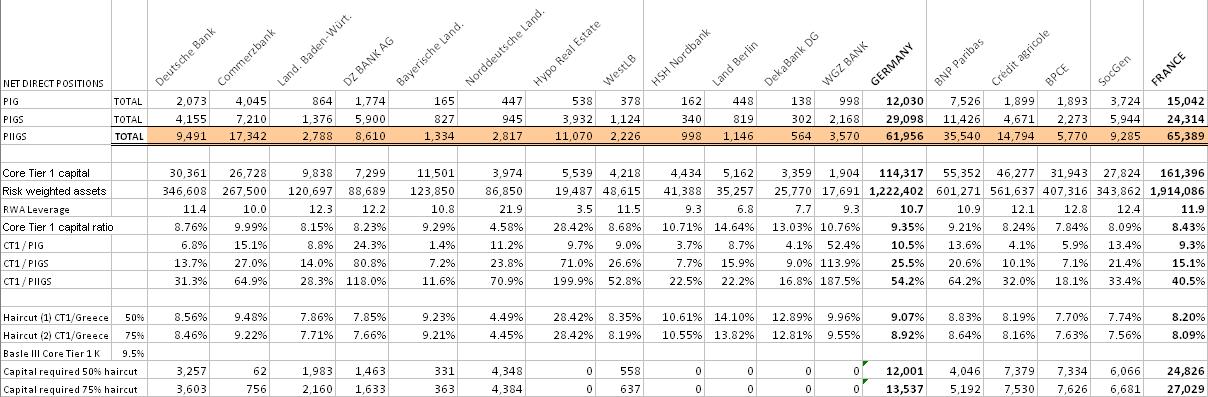
In the table below, let’s look at German and French banks’ exposure to the Greek sovereign debt (being the main holders, I do not include other banks):
A 50-75% Greek default would result EUR 36 and 40 billion new capital required, split 1/3 for Germany and 2/3 for France. This does neither take into account their exposure to the banking and private sector nor guarantees/commitments/derivatives (including CDS). The German situation is not much worse with respectively EUR 9.7 billion additional exposure (including EUR 2.1 billion with Greek banks) and EUR 5.3 billion; French banks’ are in a much more difficult position with EUR 43.5 billion (including EUR 1.6 billion for banks) and EUR 8.3 billion.
To be fair, these numbers reflect the situation at the end of December 2010 and French banks have significantly reduced their exposure on their Greek sovereign debt during H1 2011: BNP Paribas from EUR 5 billion to EUR 3.5 billion and Société Générale from EUR 2.7 to EUR 1.9 whilst producing a net 6 months result of EUR 4.7 billion and EUR 1.6 billion, so enough to absorb a 100% default. However, as for Dexia that went under mainly because of its exposure to the non-sovereign credit book, I do not know what the quality of the private book is.
Let’s add a 100% default on Greek banks and 15 % on the private sector (guarantees and commitments included but not derivatives), the banking needs required to abide by Basle III rules is north of EUR 50 billion for German and French banks that were subject to the EBA stress test.
The total number of EUR 100 billion rumored to be in the starting blocks to recapitalize European banks is probably right on a Greek basis alone. In order to weigh the minimum possible on government budgets already under dramatic strain, this recapitalization should be undertaken via profits, cutting dividends to zero and reducing bonus payments (say by the same amount as the Greek default). It is however far from addressing the rest of BIGSPIF sovereign risk.
Nevertheless, the EUR 100 capitalization does not address the core of the matter: the sovereign insolvency and lack of economic competitiveness. More on this in a forthcoming article: France - EZ weak link.
BIGSPIF = Belgium, Ireland, Greece, Spain, Portugal, Italy, France
