26 November 2010

Ireland, PIGS and the Eurozone: Here we are…

1. Bailout, bailout and bailout
A few numbers on loans provided by the IMF and the EU:
Greece: EUR 29 billion (+ EUR 9 billion to be paid in January)
Ireland: EUR85 billion (will see during the WE what the final number is)
In January, Greece will get EUR 9 billion for its third installment (I have no doubt that even if they are dissent countries, arm-twisting will do the job), representing a total of EUR 38 billion i.e. 35% of the EUR 110 rescue package dedicated to Greece. Ireland will get EUR 85 billion i.e. 11% of the 750 billion EU and IMF backstop line.
The EU/IMF bailout will take total debt to GDP of Ireland to well in excess of 100%, and, realistically, it is most probable that the total burden of debt will be shared with creditors.
The cost of a bailout on the Irish scale for Portugal would cost EUR 100 billion, based on a package of 60% of GDP. According to Bloomberg, for Spain a bailout of 60% of GDP would cost EUR 632 billion. For Italy, the region’s second-most indebted nation after Greece, the figure would be EUR 820 billion, but I am not so worried about Italy, for reasons I will explain later, I am more worried about France
The EUR 860 billion double barreled package looks rather thin when the uphill task is contemplated. Even based on 30% of GDP, there is a shortfall, and don’t forget that a number of banks would not be able to sustain the shock.
Wednesday in Paris, European Central Bank council member Axel Weber said governments can increase the size of the European Union-led bailout fund if necessary to restore confidence in the euro. “If not [the EUR 750 billion recue], it will have to be increased.” In a worst-case scenario, the fund would need an additional EUR 140 billion, an amount that would not jeopardize the survival of the euro, Weber said Thursday in Berlin. EUR 140 billion? Why not 250 or 300 or 100? And which worst-case scenario is he talking about? And can governments that are already over-indebted increase their commitment? I doubt it, and in any case not in the current format.
2. The Eurozone is a (sad) farce
I note that all the Irish banks successfully passed the EU regulators’ tests in July; as discussed in this blog at the time, these tests had no credibility being designed to defuse the risk of a EUR collapsing even faster at the beginning of the summer: fact have stayed, waffle has gone. Likewise, ongoing declaration from European leaders have no credibility at all went they explain that the crisis is under control and that Spain will not need a bailout: why Spain should be much different from Ireland when they also had a real estate bubble of the same magnitude (true there are difference regarding the solidity of the banking sector, but in essence the situation is similar)…
On November 18, the Irish Finance Minister said, as reported by the FT:
“...Brian Lenihan, Ireland’s finance minister, told Irish radio early on Wednesday the banks had “no funding difficulties.”
On November 25, asked in an interview on Punto Radio in Madrid if Spain risked having to seek a rescue like Ireland or Greece, Salgado said “absolutely not.
” The euro faces “speculative attacks”. [Ah! The speculators are back, the usual scapegoat for politicians]
“I should warn those investors who are short-selling Spain that they are going to be wrong and will go against their own interests,” 
Zapatero said in an interview with Barcelona-based broadcaster RAC1 today.
Bloomberg continues reporting:
“Merkel and Sarkozy are “impressed” by government’s budget cutting plans, today’s statement said.”
Really? I am also impressed by their consistent denial of reality. Anyway, during a financial crisis do not trust banks and politicians the least.
Let’s carry on with some spice from Portugal’s Prime Minister latest declaration: 
“There are those who think that the best way to preserve the stability of the euro is to push and force the countries that at this moment have been more under the floodlight to that aid…But that is not the vision or the political option of the countries that are involved”
Add Austria Finance Minister Josef Proell who mid-November said the EU was postponing the payment to January to wait for a final estimate of Greece's fiscal numbers, since denied. However, the IMF added:
"So far the government has been able to offset these [revenue] shortfalls by underspending at a state level, that's why the overall targets are still being met. That's clearly not a sustainable strategy going forward…The sustainability of achievements to date will only be maintained if there is a very determined effort to move on structural reform".
Whatever, it shows that dissenting is getting more voiceful, after the Slovak parliament refused to participate in the bailout for Greece on 11th of August.
This crisis is moving towards a fully blown political crisis.
This is a farce, a sad screen play written by incompetent and dogmatic politicians who are driving Europe to the wall and its citizen to poverty. Nobody listened when I claimed numerous times to some European elites that the over-indebtedness of Europe will drive to lower standard of living unless tough and unpopular measures were implemented quickly: just watch Ireland, Greece, Spain, France et al. And this is only the beginning since countries have no longer money available to soften the effect of the crisis, to the contrary. The chart below gives you a flavor:


3. The foundations of the Eurozone are flawed
As written several times, the one-fits-all does not work. A union that was meant to foster economic convergence has fueled divergence. I can only agree with David Fuller:
“The Euro is based on the assumption that one monetary policy would be appropriate for 16 different fiscal policies. The peripheral Eurozone debt crisis highlighted how incorrect that hypothesis is and policy initiatives are currently being put in place to improve fiscal cohesion. However, this does not heal the very real debt problems that were allowed to develop over the last decade.
Without currency union, countries such as Ireland, Portugal, Greece, Spain or Italy would have recourse to a significantly weaker currency to help defuse their debt problems and improve competitiveness. On the other hand, today's Euro is probably considered by many at the Bundesbank to be too weak to contain nascent inflationary pressures in Germany. This is another contradiction that will eventually have to be dealt with.
German, French and UK banks are most exposed to bank and sovereign debt in the periphery. Greek and Portuguese sovereign debt, Irish banks and Spanish banks and Cajas pose a serious threat to already weakened financials in the rest of Europe. It is for this reason that governments have been forced to absorb private sector debts. The core Eurozone quite rightly expects those who borrowed to pay their debts. Bailouts on the periphery are seen as preferable to defaults and bailouts in the core. It remains to be seen whether voters in high deficit countries will be willing to accept the amount of economic hardship required to bring debt levels back into line with Eurozone requirements.

Over the medium-term, the big question is about competitiveness. The last decade saw countries such as Ireland, Greece, Spain and Portugal substitute a focus on exports and balanced budgets for spending and higher wages and inflation. The contraction in labour and other costs, if allowed to run its course, will improve competitiveness and set the stage for a medium-term recovery. Longer-term, it is to be hoped that voters display the fortitude and integrity necessary to make sure politicians with a focus on fiscal responsibility are put in power, lest the boom to bust pattern of development prove interminable. “ [emphasis mine]
It is time for weak European countries to sit down with creditors and agree on an organized debt restructuring and an haircut; I have advocated this since the beginning of this year as I do not see any other proper way out.
4. Who is really at risk?
The data provided by the Bank for International Settlements provide some useful information which I tabulated in the following table with some added flavor.

France, Germany and the UK are by far the most exposed to PIGS countries with EUR 1 trillion. Portugal is rather over-exposed considering the size of its banking sector. One big surprise is the very low exposure of Italy, particularly when compared to France.
When the net number is calculated (even if netting does not really work this way, but at least it provides a better idea of the real exposure and the arm twisting that can be used – remember Iceland), Italy and the UK are in an enviable position, being net negative.
This is the first reason why I am more negative on France than Italy.
The next table, borrowed from Morgan Stanly, confirms that French banks are the most exposed (besides the usual winner: RBS).

The second reason is derived from the following table:
Whilst France is less indebted than Italy, the sovereign debt growth is 4 times quicker in France than in Italy, and France will catch up Italy in absolute terms next year.
In addition, Italy has a trade balance in equilibrium whilst France is heavily in deficit, showing that Italy is more competitive, an important ingredient for a recovery and eventually the reduction of the sovereign debt.
A last word, this morning, I was hearing on the French radio that residential real estate in Paris was up by 13% so far this yearwith the average square meter above EUR 7,000, , a record high, thank to low interest rates and revolving credits again available: Central banks low interest rate and liquidity creation policy is again fuelling asset bubbles (including the mother of all bubbles: government debt).
Have a nice week-end!
Source:
FT: Dublin fails to dispel eurozone debt fears
http://www.ft.com/cms/s/0/3595acd4-f7cb-11df-b770-00144feab49a.html#
Bloomberg:
http://www.bloomberg.com/news/2010-11-26/spain-depends-on-budget-cuts-to-stem-contagion-by-luring-local-bond-buyers.html
Bloomberg: Portugal Says EU Can't Force Governments to Accept Rescue Aid
http://www.bloomberg.com/news/2010-11-26/portugal-says-using-rescue-fund-can-t-be-imposed-jornal-reports.html
Bloomberg: Salgado Dismisses Bailout Risk as Borrowing Costs Surge to Euro-Era Record
http://www.bloomberg.com/news/2010-11-24/salgado-dismisses-bailout-risk-as-borrowing-costs-surge-to-euro-era-record.html
Moneynews: Greece Cleared to Get Next Bailout Installmenthttp://www.moneynews.com/Economy/EU-Greece-Financial-Crisis/2010/11/23/id/377895
www.fullermoney.com
BIS: Locational Banking Statistics
http://www.bis.org/statistics/bankstats.htm
Eurostat: European Economic Forecast - spring 2010
http://ec.europa.eu/economy_finance/eu/forecasts/2010_spring_forecast_en.htm

Quantitative Easing explained...

... with a touch of humor, but sadly true.

19 November 2010

Ireland, PIGS, QE2, the Euro and the melting pot

Today, I am going to reflect on the continuing crisis within the eurozone and the usefulness QE to spur the economy, a nice melting pot.
Greece is back behind the curtains and Ireland is on the stage under the spotlights for the continuing show of the eurozone crisis.
Summary of the previous acts
Policy makers did not want to face the harsh consequences of 20 years of easy money that led to over-indebtedness (act 1) and take the tough measures needed due to cronyism and the human nature of politicians who prefer to spend money to buy votes instead of telling voters the difficult reality of past policy mistakes. There is one reality that central bankers did not want to see is that excess liquidity leads to mal-investment, since lower returns are deemed reasonable and outright speculation becomes the norm (from individual with real real estate or stock markets - some succeeded, most failed - to CEOs who engaged in huge M&A deals to flatter their ego and grow their bank account - most created value for themselves).
The act 2 started with the financial crisis in August 2007 which reached its peak in the aftermath of Lheman’s debacle and the collapse of the real estate market. Central bank opened without any restraint the liquidity tap (should I say fire hose…) for banks 1) to get rid of junk assets (they still have quite a bit in their accounts) and 2) play the yield curve to repair their balance sheet and gain time via short term financing at no cost and investment in longer dated Government securities (you know, the famous riskless sovereign debt), making a couple of hundreds of basis points (by the way the most profitable business since you only need a couple of people to do it and you can leverage!). There is no reason to stop since Ben Bernanke QE2 is a clear signal that the FED will continue managing the yield curve to limit the cost of financing of the US Treasury whilst letting banks carry on playing the curve.
Banks (European ones in particular) poured cheap money given by central banks into government securities, without properly analyzing the inherent risks of such assets, replicating with Greece, Ireland and other PIGS (add France and Belgium), that same mistake as for CDOs and et al to gain some tens or hundreds of basis points of additional return: complacency at best...
This led to the eurozone debt crisis during H1 this year with Greece. Now, Ireland is taking the stage. In both cases, the sins lied with them, even if they are of a different nature: on one hand a cheater which did not reform itself and is totally uncompetitive and on the other hand a country that had balanced budgets and let its success running away with real estate speculation that drove its banks to the knees, hence their costly rescue and a spiraling budget deficit expected to reach 32% of GDP in 2010 despite austerity measure taken in 2009 (the first country in Europe to do so)!
This profitable yield curve play had in itself the seeds of a contradiction: why should banks lend money to a depressed real economy when they have to be more strict in their lending practice (well, financing a speculative property market is not really the same as financing the real economy, but this is an other part of the debate) and can easily make money at “no risk”.
Ant now we arrive to act 3.
Act 3
Germany had enough to pay for the sins of profligate countries; after all, and until proven differently, Germany is not a Charity. Merkel, with a reason, is fed up for Germany to become the tax payer of last resort and wants other stakeholders to pay their share of the burden: shareholders should be wiped out and bondholders (banks among the largest ones…) take a haircut. I would add, and it may be the most important act for any sustainable recovery, Boards and management should be fired (politicians too - an other story).
Large European countries, Brussels and weak eurozone countries are bullying Ireland to accept a rescue package from Europe and the IMF, while Ireland has no immediate need for funds (EUR 22 billion in their coffers). Different reason for the same objective: weak eurozone countries fear contagion and the Franco-German axis together with Brussels are targeting Ireland’s low corporate tax rate. This is the first clear of arm twisting to impose a converging taxation (upwards of course) within the eurozone. This is stupid: Ireland will be able to get out of this mess quicker than most via its competitiveness and attractiveness for foreign companies, and a low corporation tax rate is part of the solution; not the case wit Greece which has not much to show and seems however better treated than Ireland...
Between Irish and Greek bonds, you know where I would go for if I had to choose between the two. If I were Irish, I would play hard balls with the French, Germans and Brusselites to get as much as I could: this is the annoyance power since arm twisting is more or less the only language understood in Brussels, Berlin and Paris.
QE 2
The second QE decided by the FED will fail to stimulate the economy. Whilst it allowed interest rates to substantially decrease during QE 1, and therefore release pressure on many homeowners and relieve banks as well as spur the stock market, QE 2 will not add much to consumers who are either out of job with no prospect of a rapid improvement, and the wealth effect is more than dubious this time (after the crisis we are muddling thought which demonstrated that not only assets cab go down as they go up, but also collapse, who, with some sanity, is  going to borrow in order to consume on the back assets that went up thanks to the FED actions?).
QE is merely boosting asset classes, not the real economy, and attempting to inflate in order to reduce the US debt burden and debase the USD to increase export will not work, but may be temporarily - and I even have doubts (Germany have always had a revaluing currency in relative terms and continued to be the world n° 1 or n° 2 exporter; they got the products clients want: consumers want BMWs not GM cars). Playing the currency card only works if at the same time structural reforms are undertaken to become competitive on the international stage by offering the right products at the right price.
On sure thing, savers and pensioners are going to loose at this game.
I attach an interview with Jeremy Grantham, Chief Investment Officer of GMO, one of the best value investor in a generation or two, who discusses QE 2 and prospects for asset classes.
Sources:
http://www.economist.com/node/17525741
http://www.cnbc.com/id/40131748/

07 November 2010

Chart of the Day: Stock market rallies since 1900

Chart of the Day had an interesting chart showing the length of bull markets; as they commented:
the current Dow rally (hollow blue dot labeled you are here) is still somewhat short in duration and below average in magnitude when compared to all the stock market rallies that occurred since 1900
Chart of the Day adds:
Most major rallies (73%) resulted in a gain of between 30% and 150% and lasted between 200 and 800 trading days.
Whatever the imperfection of such data (where are the rallies in bear markets, that can be extremely profitable), this a useful reminder that the current bull market (or rally in a bear market) is not yet de end if history repeats itself.

Source:
Chart of the Day: http://www.chartoftheday.com/20101105.htm?T

29 October 2010

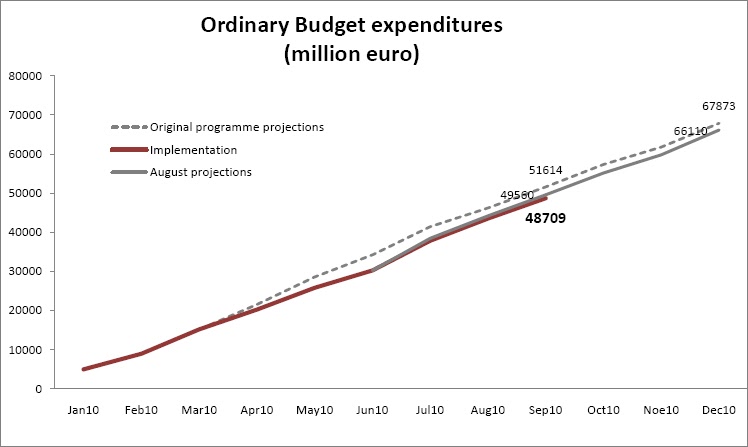
Greece’s Budget Execution Program: Jan-Sep 2010

As readers of Markets & Beyond know, I am closely following the implementation of the Greek budget. Its most recent release (20 October) leads me to conclude that the Economic Policy Program (“EPP”), which takes into account stability measures decided in March and May and implemented since, will not be met.
At the end of September, cumulated revenues were running behind schedule at EUR 36.5 billion whilst they should be standing at EUR 41.4 billion (EUR 55.1 billion projected for 2010); the gap between projection and realization is widening: the latest data from the Greek Ministry of Finance indicate that EUR 2.4 billion revenues will not materialize with direct tax and indirect tax 10% behind schedule so far. The growing gap between tax revenues and EPP leads me to also doubt about the GDP growth forecast.
Expenditures have been reduced more than what was planned in the EPP. However, the Public Investment Budget (P.I.B.) is nearly 20% behind schedule, minimizing expenditures by roughly EUR 1 billion (I am pretty sure that this one of the adjustment variables to make the final implementation closer to projections- another one is EU grants with EUR 2 billion left in the backburner in case over a total of EUR 3.1 billion planned for 2010…) and interest payments are well ahead by nearly EUR 2 billion and this is not going to improve as the year goes.

Overall the improvement compared to the disastrous 2009 is obvious but trailing projections despite the harsh measure taken by the Greek Government and money poured y the ECB (for banks), the EU and the IMF (to match the borrowing requirements). This leaves us with a budget deficit which should be close to EUR 21-22 billion (pending numbers massaging by the EU and the Greeks). As stated in previous articles, Greece has the problem with revenues more than costs; yes, they must slim down but due to the sheer size of its debt, it is a substantial increase in revenues that will save Greece from default/restructuring, and frankly I do not see how they can avoid it.

Finally, on 20th October Eurostat released an update for EU 2009 budgets deficits for all member states but Greece:
“Eurostat has completed its enquiries on statistical compilation of the Greek fiscal data and is now undertaking a process of quality assessment of statistical source data from public accounts, in cooperation with the Greek Statistical Office and the Greek Court of Auditors. Following this process, and the release of the annual report of the Greek Court of Auditors at the beginning of November 2010, Greek fiscal data will be published by Eurostat by mid November 2010.”
On October 27, the Finance Minister, George Papaconstantinou, said a review of the 2009 budget showed the deficit was greater than 15 percent of gross domestic product, more than the 13.6% previously estimated, and more than what he said on October 7…
The final number will be published by Eurostat by mid November.
As for banks, it is time to stop bailing out cheaters and incompetents: imagine to what productive use and wealth creation the trillions of wasted money could have bee channeled to.
Source:
Greek Ministry of Finance: Budget Execution 2010 – September
http://www.minfin.gr/content-api/f/binaryChannel/minfin/datastore/13/22/51/1322514373507c0e5ac9891e0341704781f4c40d/application/pdf/Budget+Execution+Bulletin-+September+2010.pdf
Greek Ministry of Finance: Presentation on Budget Execution / January-September 2010
http://www.minfin.gr/content-api/f/binaryChannel/minfin/datastore/47/2d/e2/472de2e55ba77ae92d7972c7079c1cef806a66d0/application/pdf/Presentation+on+Budget+Execution.pdf
Eurostat: Euroindicators - Second notification of government deficit and debt figures for 2009
http://epp.eurostat.ec.europa.eu/cache/ITY_PUBLIC/2-22102010-AP/EN/2-22102010-AP-EN.PDF
Bloomberg: Greek Bonds Tumble as Government Says Tax Revenue Falling Short
http://www.bloomberg.com/news/2010-10-27/greek-bonds-drop-as-tax-collection-falls-short-of-government-revenue-goal.html

21 October 2010

The US economy: no double dip! Long equities

Whilst the double-dip theory is waning these days, I thought it would be good to review a few economic indicators that cry that no double-dip is to be expected (but for economic/monetary mistake or exogenous shock).
First, the output gap turned around and whilst still negative is not pointing to a downward tipping point. The graph below clearly shows that employment is lagging the output gap indicator. In addition unemployment peaked four months after the recession ended, which is rather short compared to 1991 and 2001 recessions where the numbers were 15 and 19 months respectively vs. 1 month for 1981 recession: it seems that the deeper the recession the shorter the recovery time (that does not say anything about the magnitude of the improvement and unemployment is still very high by US standards).
Second, retail sales have also strongly rebounded and continue to forge ahead. We are back to April 2007 and September 2008 levels.

Third, despite a high unemployment rate, individuals have largely repaired their balance sheet to levels not seen since 2000 and the 1985-1990 period. I am convinced that the debt service payment/disposable personal income ratio will shrink further however that will weigh on GDP growth but make the economy much sounder longer term. In the meantime, the savings rate has stabilized in the 6% area.

Finally, we also analyzed US federal tax receipts from the 2006 tax year (ending in September) which present an online view of the real state of the US economy, since data are provided each week. The graph below plots monthly taxes received from individuals, corporations, excise and all contributors compared to the previous year.

Data clearly point towards an improving economy since February-April 2009; this corresponds to the trough of equity markets in the Western world in March 2009. The dramatic improvement in corporation taxes paid (+20% for the 2010 tax year) show that the economy definitely turned around whilst taxes paid by individual are still sluggish but have gained traction for a year now.
Excise taxes are as close as we can get for the exact picture of the economy: they improved a lot late last year and are now in a consolidation phase but nowhere near a double dip. It is worth noting the correlation between tipping point of the excise tax collection amelioration with the stock market trough in March 2009 and the sluggishness of 2010.
All the above lead me to think me that equity markets should at worse do alright at least to the end of the year.
Source:
US Treasury: Financial Management Service
http://www.fms.treas.gov/dts/index.html
Federal Reserve Bank of St. Louis: Economic Research
http://www.research.stlouisfed.org/fred2/

29 September 2010

The magnificent 7 and equity markets - Review 9

In my previous review (10th August), I concluded: The 15% correction seems to have just been a pause in a bull market ... I stick to my no tightening by the FED expectation … and the ECB any time soon despite the rhetoric. This will be supportive to equity markets and a major tailwind.”
I have not changed my view of no double dip and the FED QE2 (USD 1 trillion dollar additional liquidity) if confirmed will fuel asset prices.
After a low reached late August on the S&P 500 at 1050, the market has since regained 100 points and is trading around its 200 days moving average which has been flat since the beginning of the summer (watch if it is turning down). The S&P500 is at the same level as in January and has yet to pass the 1200 mark again which I expect to be done by the end of the year.
Economic news from the US continue to point towards a slower GDP growth and still high unemployment, but no double dip; Europe has also showed recent signs of better growth, mainly due to German exports. Fast growing economies in the rest of the world do not show signs of weakeness.
One interesting indicator is the Commercial and Industrial Loans at All Commercial Banks in the US released Monday: it displayed the 3rd consecutive month of growth, the first time since October 2008; whilst at an extremely slow pace (USD 4 billion increase over the 3 months compared to USD 404 billion decrease between October 2008 and June 2010), it shows that banks are again net lenders to the economy and the sector is healing.
S&P 500 Banks index: the index has traded range bound for a year and has yet to decisively to breach the 165 level; there is no sign this happening any time soon and, conversely, there is no sign of a deterioration either. In my opinion, the level comes from a continuing reappraisal of the future profitability of banks with new rule domestically and new capital ratio to be adopted at the next G20 summit in Seoul in November versus their ability to pass on additional costs to customers. Positive.
Global 1200 financial index: Since July 2009, the world financial is trapped within a 20% range, 800 representing a solid floor and 1000 a ceiling difficult to pass. Reasons are equivalent to the US: new domestic/regional rules and new BIS capital ratios. However, in Asia, banks are slightly under pressure due to persisting questions about the magnitude of non-performing loans in China in a booming economic environment, whilst in Europe fears about the health of Eurozone banks regularly comes back to the forefront together with problems in Greece and Ireland in an economic environment lifeless. The index continues trading around its 200 days moving average which turned negative during the summer. Positive.
TED spread (LIBOR USD 3 mth - US 3 mth T-bills): the spread is now well below its 20 years average. OIS (displays the same pattern. The interbank market shows no stress thanks to massive QE and balance sheet repair. Positive
USD bank BBB 10 yr - US 10 yr yield: The spread continues to evolve above historical average but at stabilized in the 3% region i.e. the pre-Lheman crisis level. No sign of deterioration. Positive.
OEX volatility: OEX volatility is in the low 20% but still above its pre-August 2007 crisis. We need this indicator to stay at or below 20%. Positive.
S&P Case Shiller house price index: The latest data (July) published Tuesday continue to show improvement in the price of US home values which are back to the levels where they were in late 2003. Although home prices increased in most markets in July versus June, both Composites saw these monthly rates moderate in July.
The unadjusted data continue to be positive (2009 numbers in bracket):
Composite-10: July 2010: m/m +0.79%; y/y +4.05% (m/m +1.70%; y/y -12.70%)
Composite-20: July 2010: m/m +0.65%; y/y +3.18% (m/m +1.66%; y/y -13.25%)
As the report comments:
“While we could still see some residual support from the homebuyers’ tax credit, which covers purchases closing through September 30th, anyone looking for home price to return to the lofty 2005-2006 might be
Disappointed. Judging from the recent behavior of the housing market, stable prices seem more likely.”
“… the monthly rates also seem to be weakening. The next few months may give us an idea of the true strength of the housing market, as the temporary economic stimuli will have ended. Housing starts, sales and inventory data reported for August do not show signs of a robust market, and foreclosures continue.”
Signs are mixed and do not point towards a rapid recovery. Average.
Oil price: The oil prices continue to be trade in a $70-82/b tight range. Not much happening on the energy front. In the US natural gas prices trade well below $4/btu from $6 I January. Uranium went up $3 to $48 since our last review early August, level where it was in October 2009, still 3 times below its peak in June 2007 at $138: Positive.
Conclusion: All these indicators are positive but for the housing market. The 15% pre-summer correction seems to have just been a pause in a bull market having recouped over 50% of the losses. The magnificent 7 are telling us that equity market continue to be resilient with no sign of turning negative (do not forget, this is a trend view not a trading view).

The corporate results season for Q3 will soon start and should be supportive; I however do not anticipate anything more than a slow increase in equity markets over the next few quarters.

Continue investing in high yielding equities / net cash companies with strong franchise and selected stocks in fast growth economies.
Despite the strong showing of some financial stocks, I continue to stay clear.

14 September 2010

BIS and new capital rules: God bless you!

The world’s top bank regulators agreed Sunday on new rules intended to make the global banking industry safer and protect international economies from future financial disasters.
The centerpiece of the agreement is a measure that requires banks to raise the amount of common equity they hold from 2% to 4.5%. In addition, banks will be required to hold a capital conservation buffer of 2.5% to withstand future periods of stress bringing the total common equity requirements to 7%. If banks needed to dip into that 2.5% buffer, they would face restrictions on how much they could pay executives or distribute to shareholders. An additional mandatory 2.5% countercyclical buffer was however dropped and replaced by a discretionary amount in the range of 0% – 2.5% of common equity or other fully loss absorbing capital to be implemented according to national circumstances. This buffer will only be in effect when there is excess credit growth that is resulting in a system wide build up of risk.

For banks, this is good news. The new minimum ratio of core tier one capital to risk-weighted assets will be 7 per cent is quite lenient, and the implementation is phased gradually until the end of 2018. Banks would have to begin raising their common equity levels in 2013. The implementation of the countercyclical buffer will be subject of lobbying from banks to make sure it is kept to the minimum possible, i.e. 0%; a lot of politics is going to get in between; the BIS should have imposed it despite cry foul from banks (European ones in particular that are undercapitalized).
 
Return on Equity of banks will mechanically decrease having to put aside more equity for the same amount of assets, everything being equal. And it is probable however that part of this will passed onto customers, especially retail ones: credit will not come cheaper.

Source:
BIS: Press release - Group of Governors and Heads of Supervision announces higher global minimum capital standards
http://www.bis.org/press/p100912.pdf

13 September 2010

Greece - January-August budget analysis

This week the Greek Government is undertaking a roashow through Europe's financial centers to explain how great the implementation of austerity measures is going in order to convince investors that they shouldn't have to pay ruinous interest rates on their sovereign debt (11.6% on Friday on the 10 years bonds, over 5 times what Germany pays).
Markets & Beyond spent hours going through the details of the Greek budget since January 2010 and looking at 2009 data as well. The conclusion is simple: whilst the budget deficit is being reduced the crisis is not over and far from it.
A simple view of the progress between revenue sand expenses shows that during the January-August 2010 period (representing 67% of the whole year):
  • Revenues received by the State represent 59% of what was budgeted in the revised numbers presented by the Greek Government in June, i.e. behind schedule (they should be at 67%). The Greeks are saying that the new measures are being implemented and additional revenues will come in to match the Economic Policy Program. I doubt it due to a continued contraction of GDP(-4% expected in 2010) and rising unemployment (11.6% at the end of June).
  • In the meantime, expenditures reached 64% of budget forecast more or less where it should be at this time of the year; interest payments are however well ahead at 84% which is due to increasing short term financing (the only way Greece can raise fund in the markets) and increasing risk premium asked by investors combined to the 5% interest payment on the rescue package extended to the country for longer term refinancing.
  • The Public Investment Program (P.I.B.) deficit is also behind schedule at 56%. I guess this is used as an adjustment variable to plug (at least partially) any large divergence from the budget by postponing investments to next year.
  • My view is that the budgetary situation for Greece will be deteriorating until the end of the year mainly due to a shortfall in revenues direct corollary to the negative economic situation. Even if one believes Greek’s budgetary projections, the debt will increase in the turn of minimum EUR 21 billion and the Debt/GDP will reach 130% (115% in 2009).
I do not know when the day of reckoning will occur: in 2011, Greece could probably continue financing its requirements via short term TBills and the rescue package for longer term funding; in 2012, Greece has to repay EUR 42.8 billion (including 11.1 billion in interests) on its bonds and EUR 36.7 billion in 2013. In 2014 and 2015, Greece will need to repay the IMF and the EU approximately EUR 70 billion per year. How long markets will wait? When German patience will run out?
The EU shares the Greek concerns because a big chunk of the country's debt is held by the region's banks (mainly French and German in the turn of EUR 111 billion according to March BIS numbers).
Greece needs time to reform its economy and witness this bearing fruits: we are not talking about 3 years (the initial length of the EUR 110 billion rescue plan) but at least 10 years. A debt restructuring is the only way to avoid a bankruptcy, whatever euro-dogmatics are saying, and the sooner the better.
Oh! And I forgot the +/- EUR 600 billion of pension liabilities the Greek state is the happy owner which represents 875% of GDP…
Last final word: a MUST-READ article written by Michael Lewis in Vanity Fair about breathtaking corruption, startling failure of societal norms, an absolute collapse of ethics on a national scale.

Source:
BIS: The international banking market - statistical annex
http://www.bis.org/publ/qtrpdf/r_qa1009.pdf
Vanity Fair: Beware of Greeks Bearing Bonds -Michael Lewis
http://www.vanityfair.com/business/features/2010/10/greeks-bearing-bonds-201010?currentPage=all
Hellenic Republic - Ministry of Finance: Stability and Growth Program
http://www.minfin.gr/portal/en/resource/contentObject/contentTypes/genericContentResourceObject,fileResourceObject,arrayOfFileResourceTypeObject/topicNames/stabilityGrowthProgram/resourceRepresentationTemplate/contentObjectListAlternativeTemplate

09 September 2010

Europe’s bank stress tests: Follow-up

On September 7, the WSJ published an article which outlined why the criteria used for the 91 European banks stress tests minimized the debt risk in their portfolios. In particular it pinpointed discrepancies between data published by the BIS and the stress tests. The CEBS did respond to the article, unconvincingly however. If transparency was real one should be able to reconcile the numbers or at least explain the differences.
There is however a series of information that corroborate a widespread skepticism about these politically motivated tests triggered in July in a panicky mood which I expressed at the time of their release (Europe’s banks stress test: not really stressful…).
  1. Among the five Greek bank tested only one failed. The National Bank of Greece successfully passed the tests with a 9.6% tier 1 capital ratio in the adverse scenario and 7.4% if a sovereign shocked was to occur, well above the 6% required. This week, the very same bank announced plans to raise EUR 2.8 billion via an asset sale (EUR 1 billion) and a combination of equity and convertible bonds (EUR 1.8 billion); these EUR 2.8 billion are to compare to the EUR 3.5 billion that the 7 banks that failed the tests had to raise… European politicians and regulators are lacking credibility indeed.
  2. Portuguese banks increased their borrowing (+0.6% August/July) from the ECB to reach EUR 49.1 billion. This is another sign of the failing health of Europe’s banking system. Irish, Spanish and Greek banks are also reliant on the ECB for funding.
  3. In July, the European Central Bank loaned 132 billion euros for three months to 171 financial institutions. ECB President Jean-Claude Trichet on Sept. 2 extended emergency lending measures for banks into 2011. The ECB has bought €61bn in government bonds – mostly of the weaker eurozone economies of Greece, Ireland and Portugal – since it launched its intervention program on May 10 as part of the multibillion-euro international bailout.
All this has resulted in a surge in the risk premium the market is asking to hold PIIGS debt which are moving towards their record highs.

And with Basel III more stringent capital ratios to be discussed at the November 11-12 G20 meeting in Seoul, I continue to stay clear from European banks.

Source:

The Wall Street Journal: Europe's Bank Stress Tests Minimized Debt Risk
http://online.wsj.com/article/SB10001424052748704392104575475520949440394.html?mod=WSJEUROPE_hps_LEFTTopWhatNews

Markets & Beyond: Europe’s banks stress test: not really stressful…
http://marketsandbeyond.blogspot.com/2010/08/europes-banks-stress-test-not-really.html

The Financial Times: ECB steps up eurozone bond buying
http://www.ft.com/cms/s/0/a70e9b82-bb76-11df-a136-00144feab49a.html

The Financial Times: Portugal suffers as lending costs soar
http://www.ft.com/cms/s/0/0e3b7f1a-baa9-11df-b73d-00144feab49a.html

Bloomberg: Europe's Banks Stressed By Sovereign Debts Regulators Ducked
http://www.bloomberg.com/news/2010-09-06/europe-s-banks-stressed-by-sovereign-debts-eu-regulators-failed-to-examine.html

Committee of European Banking Supervisors: 2010 EU Wide Stress Testing
http://www.c-ebs.org/EuWideStressTesting.aspx